Design Tool Dys_topias
Every tool has its politics. Imagine a “design tool” that perfectly embodies a patriarchal, capitalist model. Describe one key feature.
how to design for success
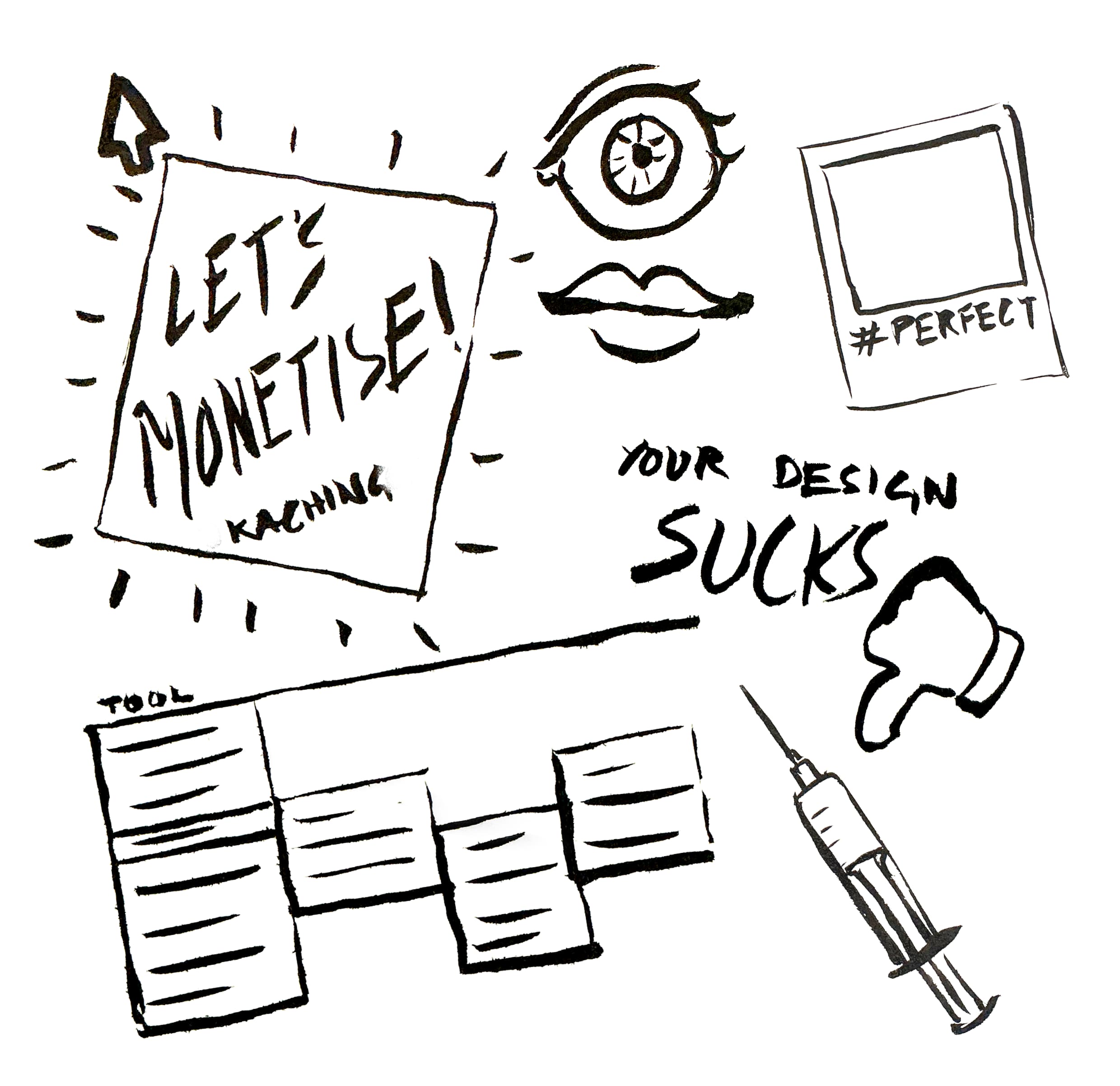
This design tool forces you to consider the commercial value of every design artifact you try to create. Design for only for joy? No more! Get ads relevant to the design you create hovering with your cursor.
how to dissolve in complexity
Tool: simultaneously quick to learn first step (simple icons), and highly specialized/technical names for features within the tool (e.g.: G8x-y feature) and highly complex steps to change initial settings or indulge deeper into the tool. it is running smoothly, but randomly doing something else, than you told it to do. gaslighting you. so you are confused whether you actually understood how to use the tool and think, you clicked the wrong icon. in order to design fruther away from the initial settings, you would either need to change the initiaö settings (which needs a complex work flow of different steps) or you would need to click on different icons in a certain order.
how to become an insular dream
A design tool that doesn’t support collaboration or participation. The tool has a dynamic pricing model and will block access if you dont agree on that. Embedded is a certain kind of censorhip that goes along with AI. The tool allows to perfecty collaborate with other tools from the same software company.
how to Score high with advertising-bot-bot
I’m imagining an AI based photo-editing tool that is trained entirely on advertising imagery. In case you want to extend the model by further training packs you need to pay a fee within the app. Simultaneously the tool runs a visually prominent success score that shows you the likeliness of public approval calculated on intransparent measures of beauty-, taste- and trend-scores. The poorer you score, the more proposals the app is making to improve your editing. Also it makes an irritaing noise the further you are off a good score.
how to Feel wholesome with automated sanitization
you pay. you pay for everything. there’s a pink tax, you have to pay a lot more if you want to install and use fonts by female type designers for example. pink or any color that might resemble femininity, queerness or equality? pay, pay and pay even more. if your design or text violates the tools terms and conditions it won’t let you export it. sometimes they might steal your designs. it also gets more expensive per month btw. one key feature is bias-based auto-correction, an algorithmic system that automatically sanitizes and rewrites your work to align with a dominant, patriarchal, capitalist aesthetic and ideology. so good luck!
how to Find shelter in the creative panopticum
A design tool that centralize every part of the creative process inside a closed corporate ecosystem, allowing the company to monitor designers in real time. Every action is tracked, evaluated, and optimized for speed and efficiency, with monthly rankings that publicly rate users by their performance. Access to advanced functions is monetized, reinforcing structural hierarchies in which designers are assigned roles like Junior, Senior, or Creative Director, and all decisions must be approved in a strict top-down order. Even aesthetic choices—such as color palettes and layout decisions—are automated to accelerate production, while users are rewarded primarily for productivity and compliance rather than creativity.
how to design or die trying
Maybe also in response to Ricardo: A communal design program in which no one is actively making any design decisions, but a system in which every user is voting on options of mashine generated designs for money. The more you vote, the higher your status and the higher your power to overrule decisions of other users. You are payed by how many of your decisions survive the voting so you need to vote as often and as agreeable as possible.
how to commodify colour
Perhaps Pantone has already created the perfect capitalist design tool. It dictates how colors are named and perceived, controls the entire production pipeline, and charges a premium for access. By owning the standards that define “correct” color reproduction, Pantone effectively shapes visual culture while selling the promise of the perfect corporate color.
how to add-on speed
like a sheep in wolf’s fur, or like a performative male reading bell hooks on a park bench…promis of happiness. It’s easy to handle, so smooth it makes you happy. And it’s affordable, everyone uses it. But the add-ons cost money. Those add-ons become new design options, that become the new trends. To keep up, you have to buy continously add the add-ons. The tool is linked to social media. The more visibility your designs receive, the more add-ons are available and the cheaper they become.
Design Tool U_topias
What is the queer-feminist, commoning alternative to that feature?
how to sneak through holes and climb over fences? (Aaron Swartz)
octomode? publish with analog tools? being a hacker? share knowledge, recipies, tips and tricks? pirate publish and print? play and display collaboratively?
how to mind a Cloud
Although it might sound scary, i am imagining a design tool that automatically reacts to and translates conversations and thoughts into design features. Is it working on speech recognition or even on brain chips? No technology, knowledge or language threshhold, just talk/ think. You can tap into a open group sessions by joining the conversation or logging into the mind cloud. All design features are editable from layout features and production methods up until micro level typography details. All file-types are accepted and interact seamlessly. The program reacts in real time and gently interrupts if contradicting concepts arise to ask if the contradictions should be solved now, later or if the project should continue with parallel versions to test iterations. At any time you could make product dummies and the users can keep iterating, referencing the features of the dummies. You can seamlessly publish online to subscriber-communities of which each subscriber has direct access to local production hubs in which they can print any project for free in high quality print on demand publications. Of course they are also free to edit and rework the publications in their personal mind cloud.
how to picklock
The are no ads. There is no one observing your clicks. You are free to experiment. Community developed solutions are suggested from time to time. Your raw file can be shared and edited to and by anyone.
how to get soft
text or image boxes would have a blurr feature, in order to unstraighten/blurr the lines of the boxes not as an extra (manual) step, but build into the text/image box. same for the baseline grid, which would have an option of making it whobbly, blurry, jumpy adding different parameters to its behaviours. another feature would be to atomatically make background rules and functions visible for export (e.g. baseline grid lines, rulers, masterpage setting, pre-settings like hyphenation rules, character settings). sliding scale payment of the tool (from 0–X€/month).
how to auto uncorrect
a queer-feminist, commoning version wouldn’t auto-correct you back into the norm, it would nudge you towards more voices, more relations, more shared power instead. it would surface type, colors and visual languages by marginalized designers as defaults, not luxury add-ons, and ask gentle questions like whose work you’re quoting, whose struggles you’re styling. it wouldn’t block or punish your export; it would offer you chances to credit, share, co-own, and feed back into the commons instead of just paying in. it would let communities maintain their own palettes, presets and guidelines as shared resources, so the tool becomes a meeting place rather than a gatekeeper. in short: instead of disciplining you, it keeps asking how your design can contribute to collective care, visibility and solidarity.
how to unionize a tool
I think the underlying structure of the tool and how it’s implemented is just as important as the visual or functional design. Features like collaborative file sharing or multi-user views can be empowering, but they can also be misused for monitoring or enforcing hierarchy. A tool should be created by its users and for its users. It should foster co-authorship, collective decision-making, and democratic structures.
how to promote contemplation
I am thinking of a tool that forces slowness and pauses by slowing down access through certain workloads or overload. It could also be based on resource consumption: the more energy is consumed over a period of time, the slower the work process becomes. Alternative and local and collective resource acquisition would speed up access again.
presented to you by
US <3