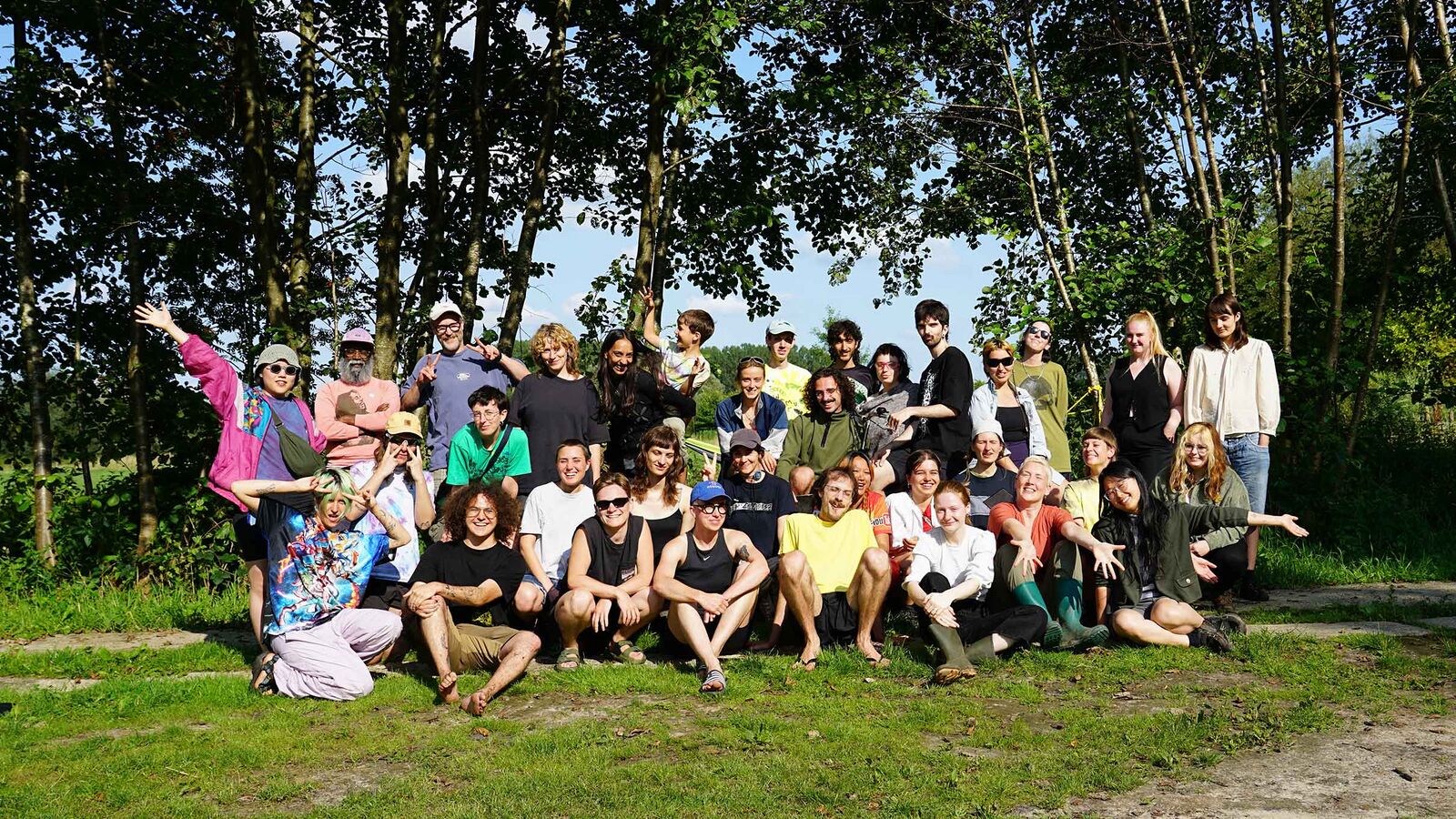
Hackers & Designers (H&D) is an Amsterdam-based non-profit workshop initiative organizing activities at the intersection of technology, design, art and education operating since 2013. By creating collective situations of hands-on learning H&D stimulates collaboration across disciplines, technological literacy, and different levels of expertise. H&D develops hands-on workshop activities, as well as lecture programs, performances, game and hack events, meet-ups, publishing experiments, and since 2015 a 10-14 day intensive summer program: the H&D Summer Camp. In addition, H&D builds free, open-source tools, self-hosts community servers, and self-publishes experimental small-edition publications.
H&D’s activities are based on a flattened hierarchy, fostering a collective venture of shared responsibility. H&D’s program bring together (h)ac(k)tivists and creative practitioners—hackers, designers, makers, artists, developers, activists, inventors—of all ages, abilities, and backgrounds. Guided by intersectional trans*feminist principles, H&D encourages collaboration across differences (age, genders, racialization, disability, skills) and builds a community aimed at creating equitable and desirable techno futures. By sharing moments of learning and disseminating the knowledge produced in our activities we are expanding the possibilities of resisting big tech solutions and fostering a wider imaginary around open source culture.
With this application, H&D seeks support from AFK to organize an intensive workshop program titled Clouds to Commons, an 11-day summer camp taking place in Amsterdam in July 2026, including a public program. Clouds to Commons is an artistic research project that approaches digital infrastructure as a creative medium, using self-hosted publishing systems to critically explore questions of authorship, collectivity, autonomy, and care in contemporary digital culture.
The camp brings together artists, designers, community organizers, technologists, and hacktivists, with a stake in open-source / self-publishing and consider self-hosting of servers as significant artistic, political, and cultural practices. Participants come from Amsterdam, and other cities in the Netherlands as well as abroad, creating a vibrant hub in Amsterdam-Noord for the time of the camp. Participation does not require prior technical knowledge; workshops are structured to welcome different levels of experience, children are welcome to join.
The NDSM area has a long history as a site of technological innovation, collective labour, and knowledge-sharing through shipbuilding, traces of which remain present in the neighbourhood and its residents today. By hosting Clouds to Commons at NDSM Kunststad, H&D builds a bridge between this industrial past and contemporary artistic practices that critically engage with digital infrastructure. At the same time, the area is undergoing rapid transformation, with new residents and developments reshaping NDSM, making it an important moment to create shared cultural spaces where different histories, communities, and futures of the neighbourhood can meet. Clouds to Commons is important for Amsterdam as it situates questions of digital autonomy, authorship, and care within a local context shaped by histories of making and collective work. The project contributes to Amsterdam’s cultural landscape by activating a vibrant, diverse artist community while inviting local residents and broader publics to participate in accessible, hands-on explorations of technology as a shared cultural commons.
This year the theme Clouds to Commons prompts participants to treat their digital tools not as neutral technical objects, but as material for artistic experimentation and critical reflection. Collectively we will reimagine, fabulate and experiment artistically with self-hosting of servers and open-source publishing tools. Combining artistic exploration with technical skill sharing, we will collaboratively develop a regenerative publishing infrastructure consisting of self-hosted servers that reflect the artistic intentions of the participating group.
An accommodating public program, co-organized with The Hmm will contextualise and activate the process and results of the workshops. The program will cater to a wider audience through talks, performances and an exhibition that make the artistic and infrastructural experiments accessible and open to discussion.
The audience and participants should walk away with the experience and understanding of digital infrastructure as a cultural and artistic space—one that invites participation, reflection, and a rethinking of how knowledge and creativity are produced and shared.
“Cloud computing” has become the key component of today’s computing landscape. While the image evoked by the term “the Cloud” brings to life an immaterial image of data floating through the air without a root or home, it overshadows a hard physical reality. The material reality of our digital habits involves deep-sea internet cables, energy guzzling server farms, precious metals mined for a large variety of chips and more “stuff” to make up what we now call “the cloud”. Or, as it is often joked about in tech communities; “There is no Cloud just somebody else’s computer.” The tangible “stuff” that connects computing to everyday reality is largely owned, governed and designed by corporate big tech companies that make all their decisions based on profit maximisation. Sustainability, social equity and democracy are not at the center of how these everyday infrastructures are built, developed and maintained. There are alternatives, but their mere existence has proven to not be enough to guarantee uptake. A large barrier for the uptake, is the necessary technical know how. This has become apparent to us over the years through our workshops and collaborations with initiatives outside of the computing field. Our collaboration with Learning Palestine is an example of this (find more about this collaboration later in the application). With Clouds to Commons, we aim to address this problem by making knowledge about self-hosting that can be rather illegible and inaccessible to non-tech savvy communities, more accessible. In other words: we aim to bring the Cloud back down to Earth as well as disperse it.


H&D aims to deepen its narrative and world-building approach to organising hands-on practical and technical workshops, by treating the Summer Camp as a living commons: responsibilities rotate, stories accumulate, and each day folds into the next like an exquisite corpse. Daily publishing and occasional radio broadcasting during public programs make the process transparent and open for wider audiences, while a partnership with The Hmm allows a wider reach of the activities in Amsterdam and beyond. The program will also be open for caretakers/parents to join with their children, with the help of a pedagogical assistant the younger participants will bring their creativity and join the discussions.
1. Speculative Fabulation
Through guided experiments in world-building, character development, and
visual storytelling, participants will explore alternatives to the cloud
not only as technical systems, but as cultural imaginaries shaped by
myths, promises and power relations. These experiments take the form of
collective storytelling sessions, visual mappings, and performative
exercises in which participants invent fictional communities and the
digital infrastructures that sustain them.
For example, participants might imagine and prototype a local publishing server run by a neighbourhood, a migratory archive that moves with its users, or a server that operates according to ecological rhythms rather than constant uptime. By assigning values, rituals, constraints, and narratives to these infrastructures, participants are encouraged to ask different questions: Who maintains the system? Who is excluded? How does care, authorship, or failure appear in the design?
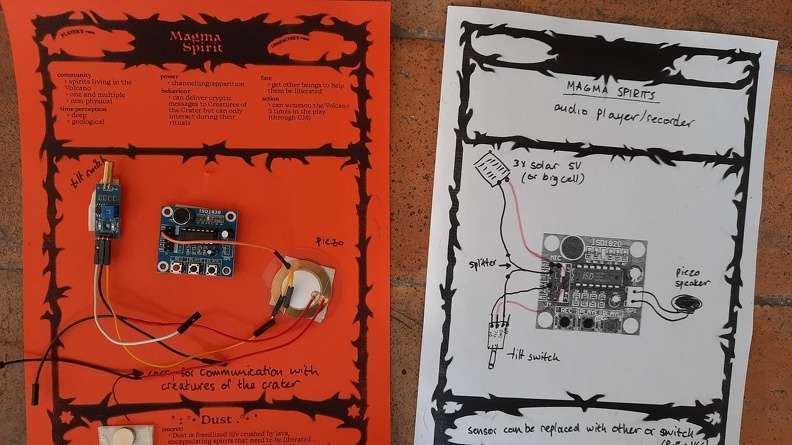
Building on previous H&D projects such as Sounds from Earth, Solarpunks, and The Age of Dust, these fictional frameworks are then translated into concrete design decisions for the evolving publishing infrastructure during the hands-on workshops. Inspired by thinkers such as Donna Haraway or Saidiya Hartman, Speculative Fabulation becomes a critical tool that allows participants to step back from dominant technological paradigms and prototype alternative socio-technical futures in a tangible and situated way. Collective world-building creates a shared space of imagination that supports critical reflection, collaboration, and experimentation, resulting in infrastructures that are not only functional but also culturally and artistically grounded.
2. Hands-on hacking
Hands-on hacking forms the material core of the Summer Camp and treats
technical intervention as an artistic and critical practice.
Participants will work directly with low-bandwidth setups, reused and
repurposed hardware, and free/libre open-source software to build and
modify self-hosted publishing infrastructures. These sessions include
collectively configuring servers on minimal machines, stress-testing
publishing tools under constrained network conditions, and experimenting
with alternative interfaces that prioritise slowness, locality, and
accessibility.
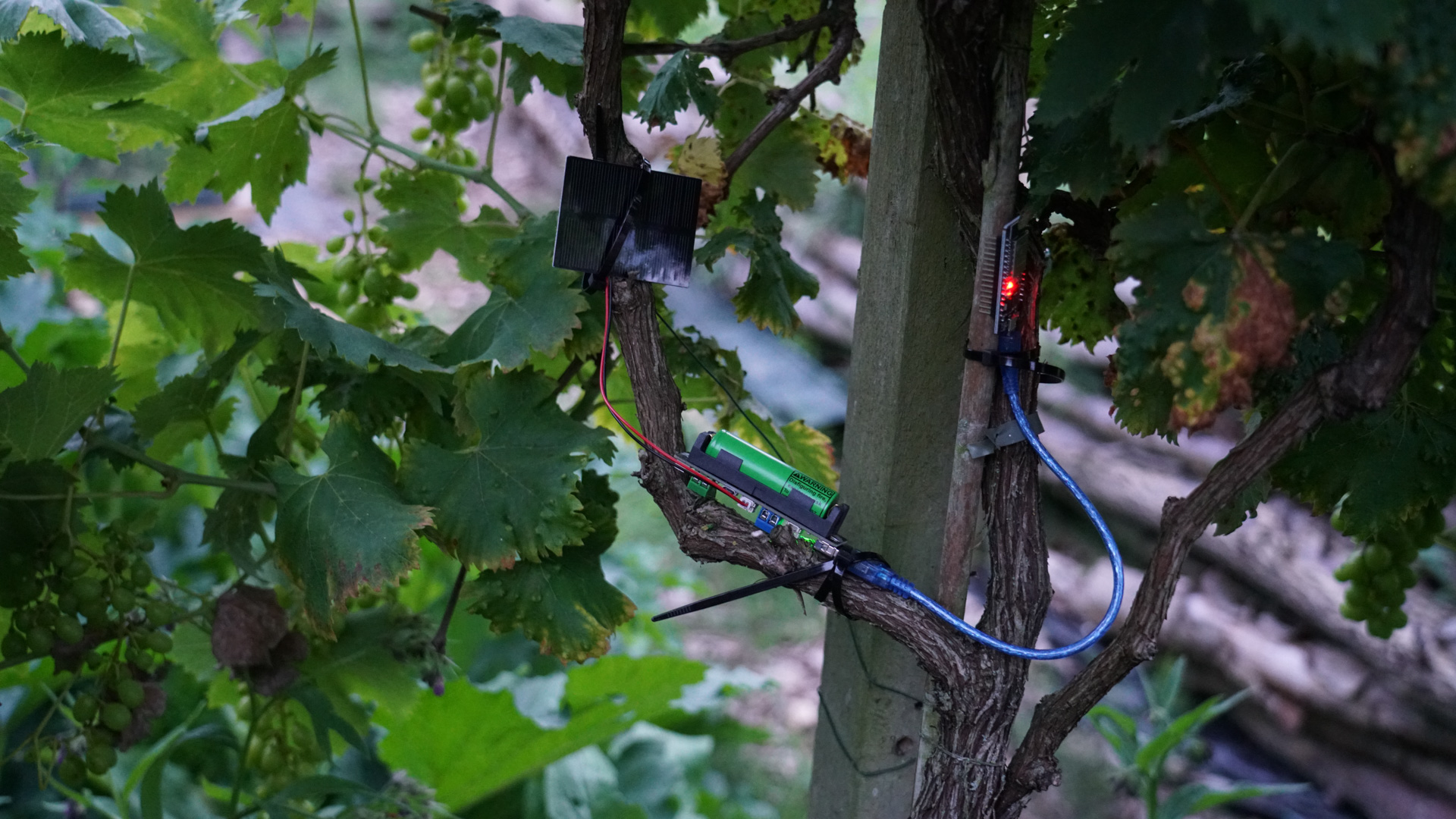
By intentionally working within technical limitations, participants confront the material realities of digital systems and the global inequalities embedded in mainstream, resource-intensive technologies. Hacking in this context is not about optimisation or efficiency alone, but about revealing hidden dependencies, questioning norms of constant availability, and resisting the logics of disposability and extraction. Through these hands-on experiments, technological constraints become artistic parameters that shape both the aesthetics and ethics of the infrastructures produced.
3. Collective learning and empowerment
The Summer Camp fosters a hands-on, collaborative environment where
risk-taking, curiosity, and experimentation are encouraged. Rather than
a bootcamp with pre-determined outcomes, it is conceived as an immersive
communal experience in which participants co-create the learning process
itself. This open environment allows individuals to try new tools,
methods, and approaches that they might not feel confident experimenting
with alone, turning uncertainty and failure into generative, artistic
opportunities. Through shared workshops, peer-to-peer tutorials, and
lectures, they gain insight into the hidden material, social, and
environmental dimensions of digital infrastructures.
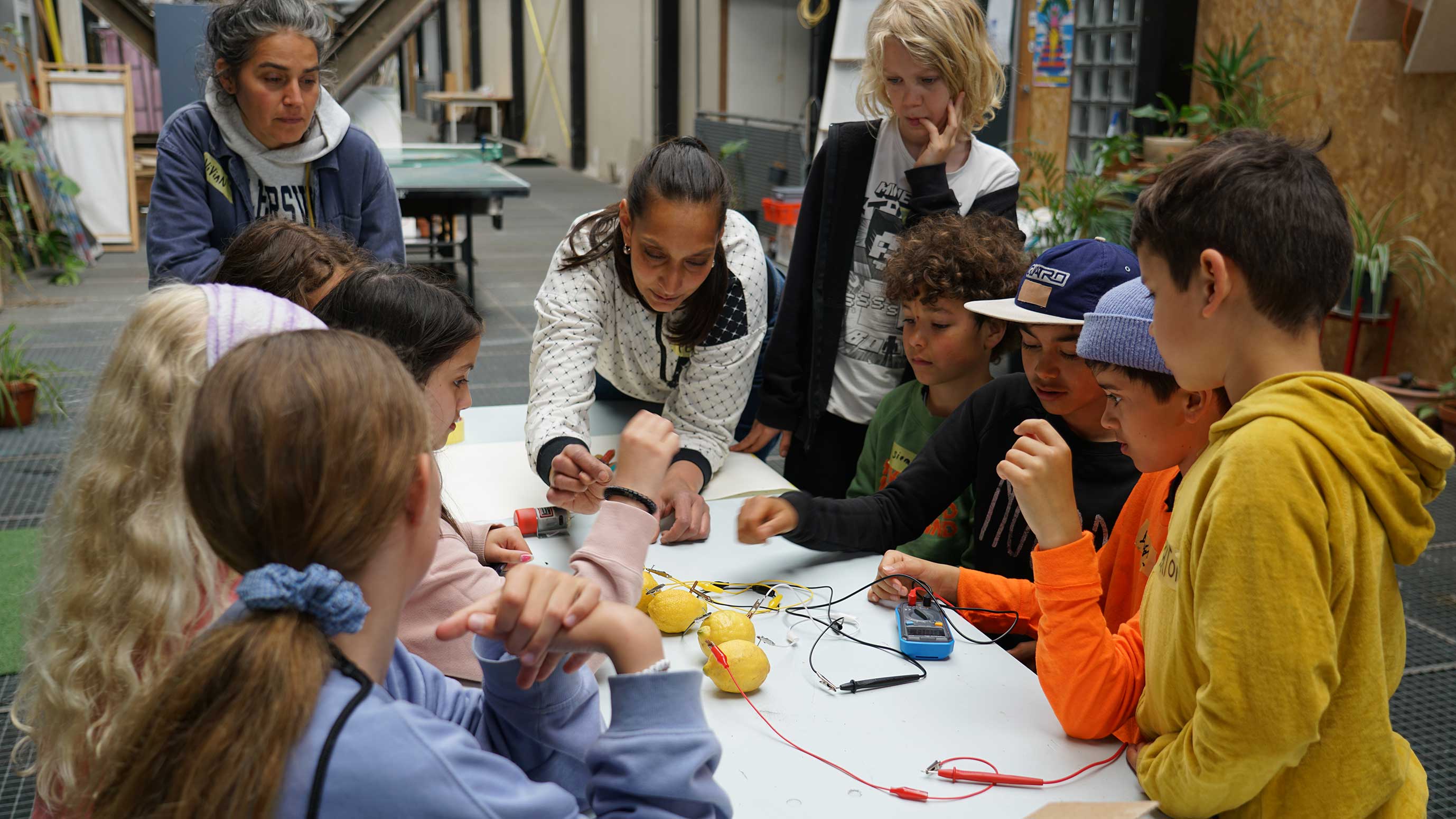
By intentionally blurring the roles of participants, tutors, and mentors, the program cultivates a dynamic ecosystem in which everyone contributes expertise, imagination, and feedback. Each to their own ability, children can also be teachers. Activities such as co-designed sharing sessions, daily documentation, and collaborative public events create iterative cycles of experimentation and reflection. In this way, participants not only transform the tools and infrastructures they engage with, but also develop new ways of working together—practices grounded in care, shared responsibility, and accessibility—that continue to inform their creative and professional lives beyond the Summer Camp.
4. Instant Publishing
Reflection and knowledge-sharing are embedded into the daily rhythm of
the Summer Camp through communal publishing activities. Each day,
participants contribute to a shared digital platforms through writing,
documenting, and producing multimedia outputs, that make the creative
and technical processes visible both to the group and to a wider public.
These activities include visual maps of infrastructures, collaborative
zines, live updates on social media, and radio broadcasts, offering
multiple formats for storytelling, reflection, and experimentation.
In addition to daily outputs, participants contribute to ongoing H&D publishing projects during and after the camp, creating a continuum of engagement that extends the life of their experiments beyond the immediate workshops. This practice of “instant publishing” ensures that knowledge, creative insights, and technical discoveries are shared openly and collectively, turning reflection into tangible artefacts that others can engage with, remix, and build upon.
Through these publishing practices, H&D envisions a future in which self-organised, communal infrastructures foster equitable access to knowledge and empower participants to imagine and practice alternative technological worlds. Publishing becomes both a tool for critical reflection and a medium through which the creative, social, and political dimensions of digital infrastructure are made legible and actionable.
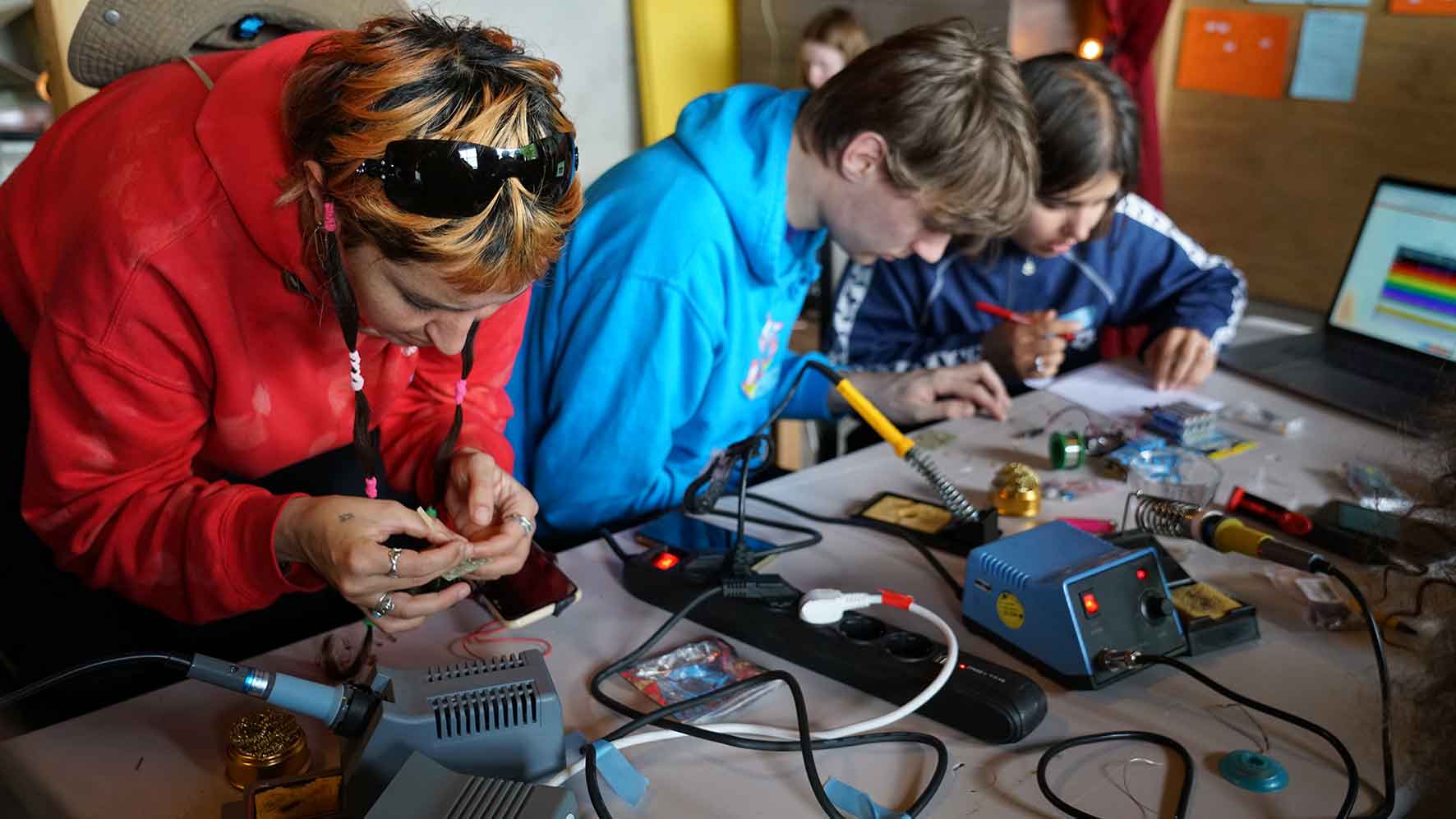
Hackers & Designers Summer Camp 2026 will take place over 11 days from 13th to 23rd of July.
The program is divided in different stems:
Monday 13 July 2026: Landing & Setting the scene
Public Program Input Talks #1 at NDSM Theatre
Tuesday-Wednesday: Connecting to Other Clouds
The first two days will be dedicated to hands-on workshops to
familiarise everyone with open-source, low-impact server devices to host
open source publishing tools. (by H&D Heerko van der Kooij &
vo.ezn & Karl Moubarak)
Thursday: Show & Tell – Open Skill Sharing – internal peer-led
Public Program
Friday-Saturday: Re-imagining & Dreaming the
Cloud
These two days will focus on using publishing as a methodology to
reimagine and fabulate ON “the cloud” as a socially grounded and
community-driven infrastructure rather than a corporate-controlled
service. H&D will introduce their collaborative publishing tools and
workflows that allow co-writing, co-design, co-editing.
Saturday lunch
Public Program: Input Talks #2 Lumbung & Learning
Palestine
Sunday: Off
Monday 20: Show & Tell – Open Skill Sharing – internal peer-led
Public Program: Input Talks #3 Server Tempeh Dinner
Tuesday - Wednesday: Grounding the Cloud
Thursday: Clouds to Commons: Publi/c/shing Program
18.00-23.00 Public Program &
Exhibition
The exhibition and public program are curated in collaboration with The
Hmm to make the underlying digital infrastructures developed during the
workshops tangible, legible, and engaging for a broad audience.
Hardware, software, and produced content will be presented alongside
visual storytelling, interactive displays, and performative elements,
such as live printing and audio broadcasts, that allow visitors to
experience the systems in action. By combining aesthetics, narrative,
and hands-on interaction, the program transforms abstract infrastructure
into an accessible and immersive artistic experience, appealing not only
to technologists but also to local residents, artists, and curious
newcomers. Local small-scale publishers and collaborators further
situate the program in Amsterdam’s cultural landscape, ensuring
relevance and connection to the wider community.
**From 20:00 Input Talks #4 Fast Pace by The Hmm with contributions by participants of the Summer Camp, Hum Drum Press, Martine Neddam and Daniel de Zeeuw.
21.30-23.00 Printing Performance
The public program will be open to wider public (expected audience number including summer camp participants: 150-200). In addition we will personally invite local small-scaled publishers like outline, terry bleu, kiosk, Spookstad, Sans Serriffe, Everyday Technology Press, as well as artists working with printing matters and text, to engage them in discussions and practical implementation of alternative open source-publishing infrastructures and workflows.

1. Artistic and infrastructural outcomes
2. Publications and documentation
3. Public engagement and dissemination
4. Knowledge and collective learning
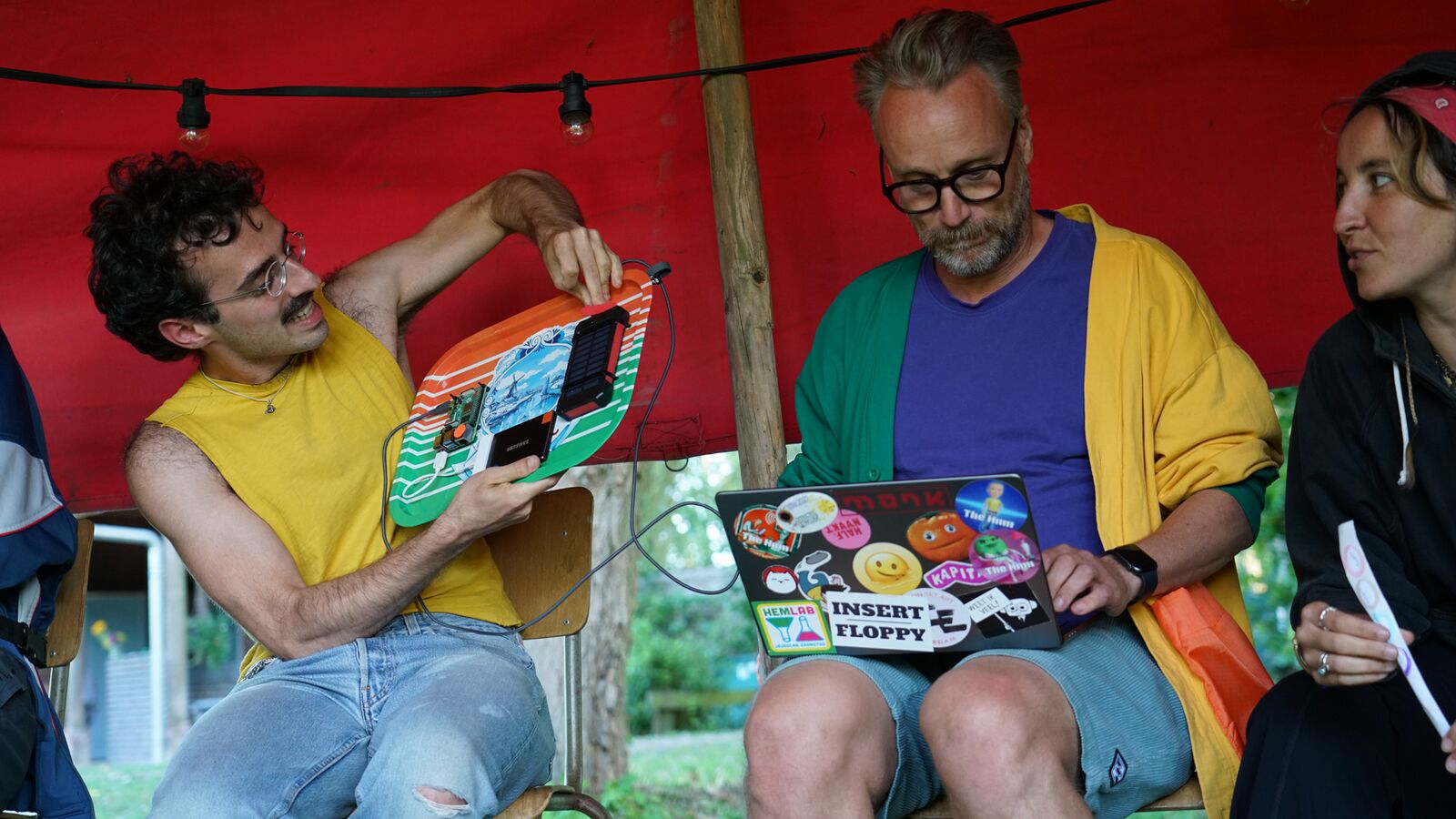
Expamples of projects that emerged from previous Summer Camps:
From evaluation forms and participant feedback from previous editions of the H&D Summer Camp, we have learned that especially the hands-on approach to our programs, as well as the emphasis on collective learning and community building, and the attention we pay to selecting diverse participant groups such as queer and disabled community, resonates strongly within our network and beyond.
H&D’s thematic threads are often inspired by artistic practices of its organizing group and the wider community in our orbit. We tap into genres such as eco and transfeminism, science-fiction, solarpunk and hopepunk, which induce urgency to our programs, timeliness, – offering critical yet hopeful outlooks for working towards holistic and intersectional ways of practising sustainability and regeneration (technically, socially, ecologically, economically, culturally).
The limitation of hands-in workshop format typically accommodates only a limited number of 20-30 participants at a time. We achieve wider audience reach by combining longer, intensive workshops with a public talk, exhibition, or performance.
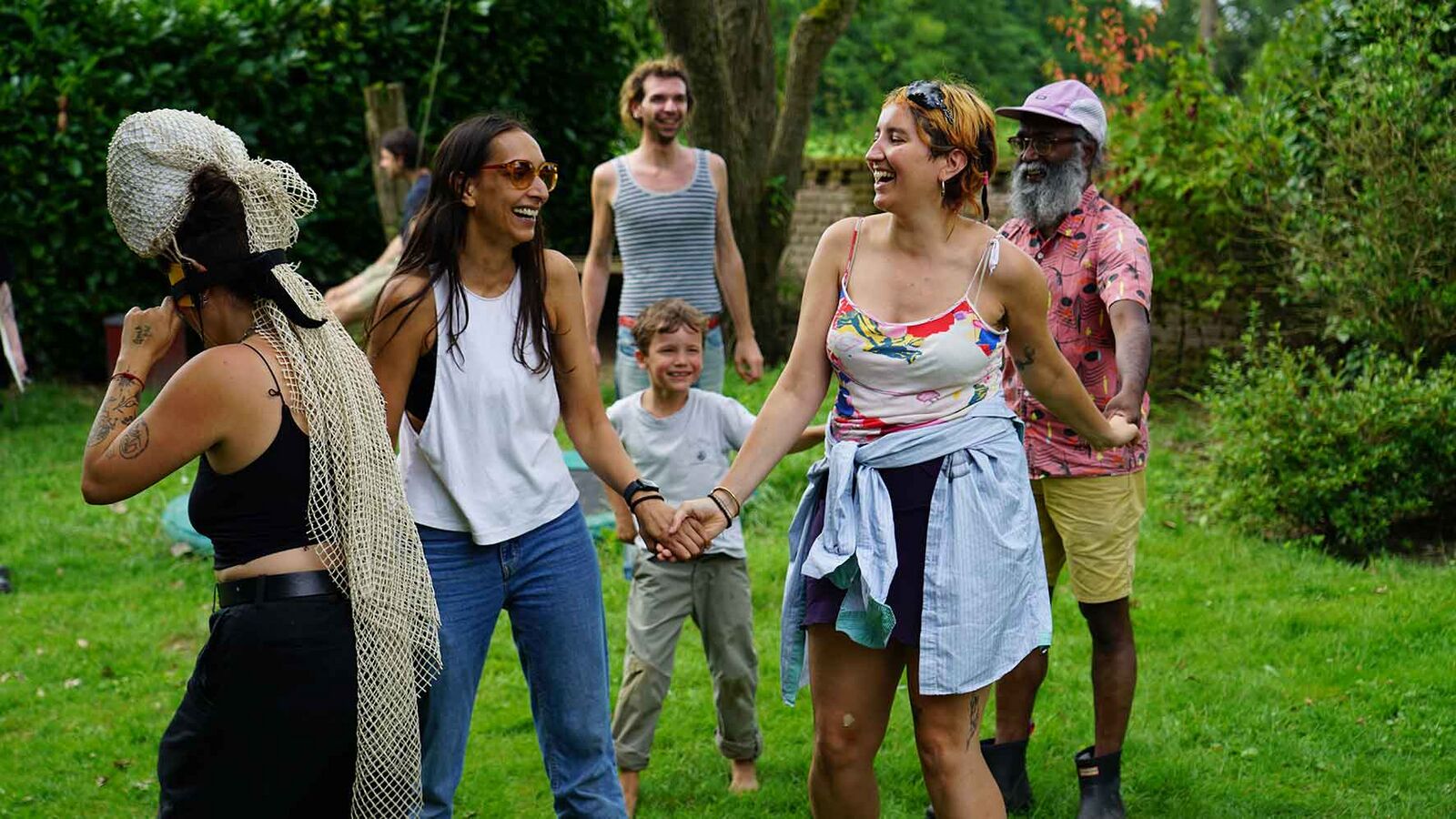
The current organization of the summer camp responds to participant feedback from previous years, and has been praised as being a uniquely caring, inspiring, energizing, as well as a safe collective experience rooted in mutual respect and solidarity. The last Summer Camp H&D organised in 2024 premiered a kids-friendly workshop track to make the experience accessible to multiple generations, developed with MU Hybrid Art House. Their education department helped us translate complex topics to the younger (6-12 years old) campers and visitors of the public program on the weekend and brought a festive intergenerational quality to the open days that were well attended.
Intergenerational learning allows different skill sets to exist side by side. A child’s perspective, fascinations, and intuitive playfulness are acknowledged as meaningful forms of knowledge. This aligns with H&D’s non hierarchical approach to learning, where children and adults learn with each other rather than above or below. When adults learn alongside them, children feel they can influence what happens, not just follow instructions.
Impact of previous H&D Summer Camps (since
2015)
Since 2015, the H&D Summer Camp has functioned as a recurring
platform for artistic experimentation, skill-sharing, and community
formation at the intersection of technology, art, and critical practice.
Each edition has brought together international and local groups of
artists, designers, technologists, and activists, many of whom continue
to collaborate beyond the duration of the camp. Outcomes of previous
editions include open-source tools, publications, long-term working
groups, and spin-off projects that have been presented at cultural
institutions, festivals, and self-organised spaces in Amsterdam and
internationally.
Examples are: Former participants have established important critical technological platforms such AIxDesign initiated by Nadia Piet. H&D has contributed to the environmentally conscious low-res streaming practice of The Hmm. Bringing makers from across the world to Amsterdam such as the Seoul-based artist group dianaband inspired participants such as Benjamin Earl to continue their practice and proposed technologies such as the small file Wifi Publishing workshop to other places and communities.
Equally important has been the development of a sustained learning community: participants often return in different roles, as mentors, collaborators, or organiser, contributing to the continuity of knowledge and collective memory within H&D. The camp’s emphasis on accessible, hands-on learning has enabled participants from non-technical backgrounds to engage critically with digital tools, lowering barriers to participation and fostering confidence in working with technology as an artistic and cultural medium.
Long-term impact for Amsterdam
In the long term, Clouds to Commons strengthens Amsterdam’s
cultural ecosystem by supporting artist-led, commons-based approaches to
digital infrastructure at a moment when technological systems
increasingly shape public life. The Summer Camp builds on H&D’s
ongoing work in the city, such as the
self-organisation meet-up co-organised with Platform BK at de Appel,
which brought together artists, cultural workers, and technologists to
exchange knowledge on self-hosted servers and collectively managed
technological infrastructures. By combining hands-on artistic research,
public programming, and open publishing, the project embeds practical
knowledge and critical perspectives within Amsterdam’s artistic
communities, contributing to a culture of technological literacy, shared
responsibility, and care. Through sustained networks, recurring
activities, and openly accessible outcomes, Clouds to Commons
reinforces Amsterdam’s position as a city that values experimentation,
openness, and socially engaged artistic research around technology.
H&D’s relationship to publishing stems from the intention to widen the reach of our activities, document and disseminate what is being produced in short-lived workshop-based programs. H&D documents and disseminates the lessons and propositions that emerge from our workshops through various on and offline publishing formats. Beyond that, the digital infrastructures and open source tools we build are themselves artistic experiments and create tangible alternatives to “the cloud.” By collectively building, maintaining, and sharing our own servers, we challenge the abstraction of cloud technologies and make the material/ecological, political and social dimensions of computation visible.
We want to foreground this part of H&D’s practice during HDSC2026, where we will reimagine cloud practices not as abstract and inevitably extractive, but as situated, grounded, and regenerative. Together, we explore what it means to build resilient tool ecologies within our communoutside the monopolies of Google, Microsoft, and Apple.
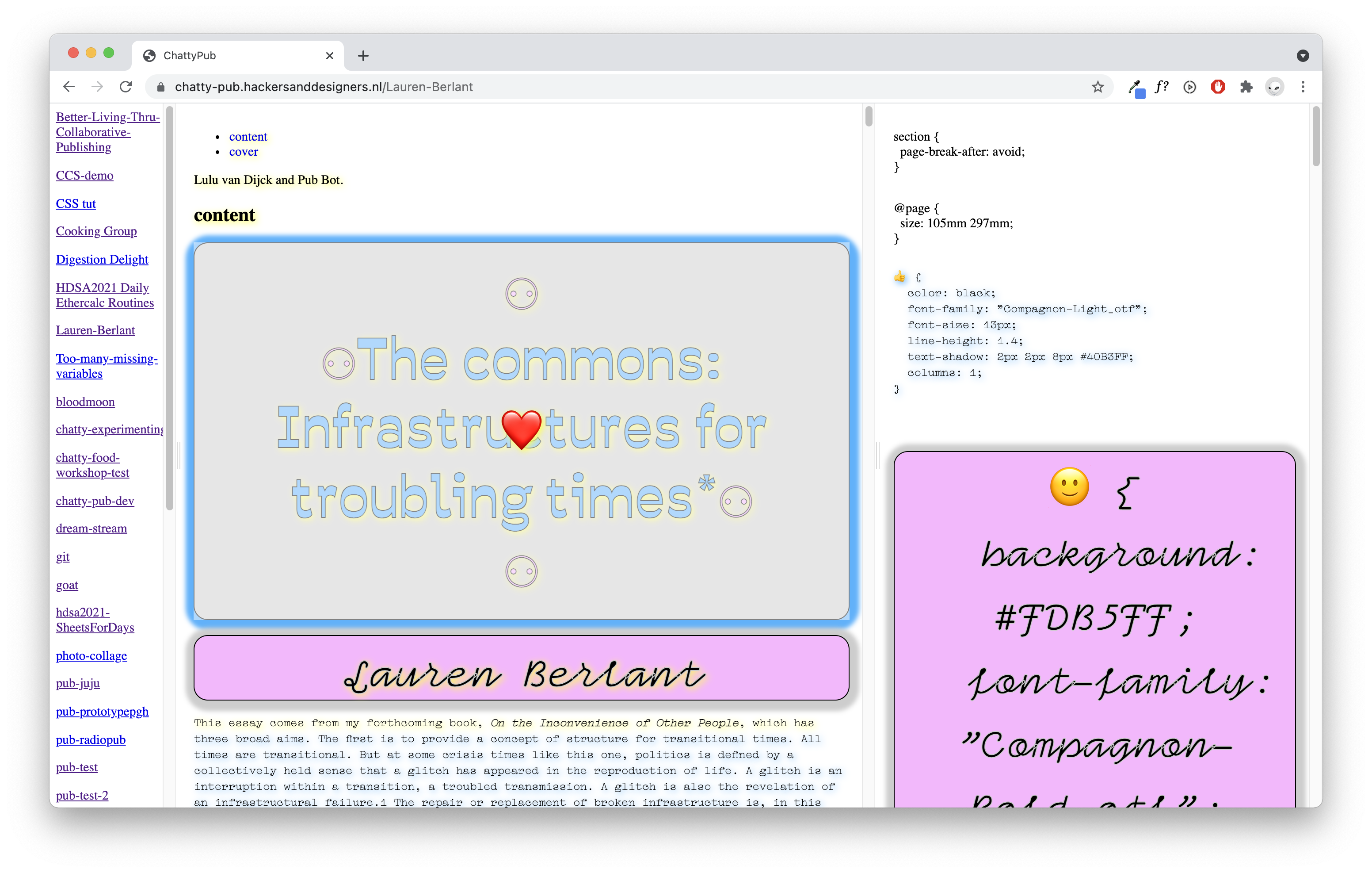
This approach is in line with previous projects such as our recent collaboration with Learning Palestine that confirm the necessity and power of open source collaborative publishing tools in becoming vehicles of solidarity, political and technical literacy. Learning Palestine is a volunteer-run initiative of artists and activists who translate and republish texts, and circulate pamphlets across community spaces and bookshops worldwide through decentralized networks of trust. Despite the strength of these networks, initiatives like Learning Palestine face bottlenecks at the design and editing stage, where dependence on commercial cloud services such as Adobe Creative Suite but also editing tools as Google Docs clashes with their values. Furthermore some of the tools they use are complicit with the military complex, ecocide and war crimes.
H&D collaborated with Learning Palestine to experiment with self-hosted and open-source alternatives that allow for writing, editing and designing publication collaboratively. One idea emerging from this ongoing collaboration is the possibility for Learning Palestine to host a self-contained, portable instance of the tool on a local server, allowing them to travel with their publishing infrastructure and avoid reliance on extractive global platforms in the future. This example illustrates the broader ambition of Clouds to Commons: to develop regenerative publishing infrastructures in dialogue with specific artist and activist communities, letting their needs shape how tools evolve, how servers are configured and maintained, and how infrastructures remain situated, collective, and sustainable over a long time.
April Pre-production phase
April-May Research and development
May Production and Outreach
May-June
June
July
September-December: Post-production
H&D supports the Fair Practice Code. For the honoraria of our self-employed members we have been using the Guideline ‘functie- en loongebouw Presentatieinstellingen’ of De Zaak NU. We also apply the Governance Code Culture. Although Hackers & Designers is legally constituted as a stichting—and therefore complies with the administrative and legal requirements associated with that structure—the organisation functions in practice according to flattened organizational principles. Decision-making, responsibilities, and day-to-day operations are collectively managed by the members, reflecting a cooperative mode of working.
H&D operates in a cooperative manner. Everyone is encouraged to make proposals, programs are developed jointly, and participation in projects or commissions is voluntary. We maintain accessibility in both social and financial terms: the camp’s participation fee will be based on a sliding scale (150-300) depending on participant’s financial possibilities and offering 3 full bursary spots, public events will be low-cost or free, held at locations with step-free access whenever possible. When accessibility limitations exist, these are communicated clearly in advance. Our Code of Conduct [https://hackersanddesigners.nl/code-of-conduct], first published in 2020 and regularly updated, ensures respectful participation and engagement with all participants and partners.
Decision-making at H&D is horizontal and participatory. All members contribute to program planning, choice of partners, and guest invitations. We perform due diligence in selecting collaborators and projects, ensuring that perspectives enhancing the collective’s diversity and network are actively considered. Our communication emphasizes clarity and accessibility: for example, materials for younger audiences are translated into Dutch, and we plan to expand bilingual communication to reach growing audience groups. The Code of Conduct is shared and discussed with participants and partners at every program to ensure shared understanding of expectations and values.
H&D endorses the Diversity & Inclusion Code and actively integrates social engagement and artistic integrity into both its organisational structure and its programming. Our organising group is diverse in terms of age, gender identities, racial and cultural backgrounds, abilities, and technological affinities, and this diversity directly shapes the themes, formats, and facilitation of our activities. We work from principles of intergenerational exchange, queer-friendliness, trans*feminism, racial justice, and disability justice, and understand inclusion as an ongoing practice rather than a fixed goal.
Accessibility is embedded in the design of the Summer Camp and its public program. Participation does not require prior technical knowledge; workshops are structured to welcome different levels of experience, and communication is intentionally clear and jargon-aware. We apply a sliding-scale participation fee to lower financial barriers and actively encourage applications from individuals and communities that are underrepresented in technological and artistic fields.
The Summer Camp is designed to allow for different levels of intensity of participation. This makes it possible for participants with care responsibilities, chronic illness, or fluctuating energy levels to take part in ways that are sustainable for them. Ahead of the workshop program and public events, participants are invited to share access needs and constraints, which are taken into account in the scheduling, pacing, and facilitation of activities. Closed captioning, interpreter and other accessibility measures can be put in place accordingly. A dedicated team member is responsible for coordinating access needs and supporting participants throughout the program, ensuring that care and flexibility are actively upheld rather than treated as exceptions. Participants with children are welcome to join, childcare will be shared among participants as well as with support of a pedagogical assistant a few hours per day.

Participants are selected through an open call that is widely disseminated via our networks, partner organisations, and community channels in and beyond Amsterdam. Selection is based on motivation, curiosity, and the potential to contribute to and benefit from a collective learning environment, rather than on formal credentials or technical expertise. We aim to assemble a group with diverse perspectives, practices, and lived experiences, ensuring a balance across disciplines, backgrounds, and levels of experience.
H&D collaborates with a broad range of partners across Amsterdam and beyond, enabling us to reach audiences outside established cultural and technological circles. Through these practices, we strive to create inclusive, welcoming environments in which participants and audiences feel empowered to experiment, learn, and contribute, while remaining committed to reflection and continuous improvement in our approach to diversity and inclusion within digital culture.
H&D reaches diverse audience groups through targeted outreach via community networks, artist-run spaces, adult education initiatives, and grassroots organisations in Amsterdam, including collectives working with people new to artistic practice, individuals without formal technical training, and practitioners operating outside institutional contexts. We actively use peer-to-peer invitations and collaborations with initiatives focused on migrant communities, queer and trans communities, people with care responsibilities, and self-organised learning environments, ensuring the program reaches beyond dominant art and technology circuits. Free and low-threshold public events function as accessible entry points, enabling residents, cultural workers, and artists at different stages of their practice to engage with the program without prior technical knowledge or familiarity with H&D.
At Hackers & Designers, sustainability is central to both our organisational practices and creative work. In our digital and technical practices, we consistently use open-source software, reinforcing our commitment to transparency, accessibility, and community-driven development. We are mindful of the materials, components, and tools we use, prioritizing re-use, adaptation, and iteration over immediate consumption of new resources. This approach includes designing with existing materials, giving items a second life, and building on previous projects rather than following the latest technological trends.
Food and catering are treated with the same care, with an emphasis on thoughtful and responsible choices. For example working with zero waste food collection.
As a collective, we are guided by a mission to practice what we preach: advocating for equitable and sustainable techno-futures, promoting approaches based on the commons, and challenging monopolistic practices in Big Tech that contribute to social and climate injustices. Sustainability at H&D is approached holistically and intersectionally, encompassing ecological, social, economic, technical, and cultural dimensions. Through experimentation we explore regenerative practices that are socially, technically, and environmentally responsible, continually learning and iterating on how to operate more sustainably as a community.
Reaching beyond a niche audience
While H&D originates from a specific art–technology community, the communication strategy for Clouds to Commons is intentionally designed to reach broader groups of Amsterdammers who may not identify with this niche but are affected by, curious about, or concerned with the role of technology in everyday life. We do this by translating the project’s themes—digital infrastructure, ownership, and care—into accessible, relatable entry points such as neighbourhood history, collective making, publishing, and public discussion.
Public-facing activities such as the guided NDSM walk, shared meals, radio broadcasts, talks, and the final exhibition are communicated as cultural and social events rather than specialist technical programs. Language in our communication avoids jargon and emphasises lived experience, storytelling, and relevance to daily digital practices (e.g. platforms, publishing, archives, communication). This allows audiences without prior technical or artistic expertise to engage meaningfully with the content.
In addition to our own channels, we actively place communication in contexts that reach wider Amsterdam audiences: local cultural agendas (iamsterdam.com), city-based art and culture media (Metropolis M), neighbourhood-based visibility at NDSM, and partner networks such as The Hmm, whose audience includes students, educators, cultural workers, and curious members of the general public. Offline visibility through posters, flyers, and on-site signage at NDSM Kunststad plays a key role in reaching passers-by, residents, and visitors who are not already connected to H&D’s network.
By combining low-threshold public programming, place-based communication in Amsterdam-Noord, collaboration with partners who address broader publics, and clear, accessible framing of complex themes, H&D ensures that Clouds to Commons reaches beyond a specialist audience and contributes to a wider cultural conversation on technology, commons, and collective responsibility in the city.
1. Participants of the Summer Camp Workshop Program
The workshop program will be specifically targeted towards: Young and mid-career professionals between 25-55 years old with the ability to travel and commit to a 11-day program, who work in the fields of:
Within these different groups, parents with children from 6 years old as well as teenagers are welcome to join the program. We built this audience and reach newer members through workshop activities, lectures, publishing activities and collaborations with academic, societal and cultural partners that H&D is frequently invited to take part in. This group is informed of our Summer Camp activities by the open call we share via our newsletter, website, posters, as well as social media (instagram) and our radio broadcasts and through the professional networks of our 9 coop members and the wider H&D community.
H&D attends publishing fairs to promote our activities, which are places with high visitor amounts. Through the publication of reviews of our activities on platforms such as Makery we reach an international maker community.
Every year we receive 100+ applications and select 30+ participants to join the H&D Summer Camp, which throughout the years generates word of mouth visibility and a stream of applications as well as returning participants.
2. Broader target group for the public events.
The public events will be specifically targeted towards members from the same category as the workshop participants, who were not able to commit to the full duration of the program but could join one-off events according to their availability, and local applicants that didn’t make it to the final selection of participants but are still warmly invited to join the public events.
Throughout the last years we have put effort into building a wider intergenerational audience that has the potential to grow stronger with each new program, the public events are thought to be accessible to such audience:
We started building on this group through previous public programs that commissioned us for workshops, and through past collaborations or with partners who have these groups as main audience (e.g. SoundLAB). This network help spread the word on our program.
Promotion through poster campaigns, email newsletters, and placing announcements on relevant platforms for local activities such as iamsterdam.com are tactics we want to invest in more to stimulate the growth of this audience segment. We used to share our Summer Camp campaign through the e-flux Art & Education Newsletter which has helped to widen our reach but was mainly bringing us more American applicants. Since 2023 we adopted a more local approach by placing an advertisement for the Open Call for Participants with art magazine Metropolis M. In 2026 we would like to also place an add for the public program.
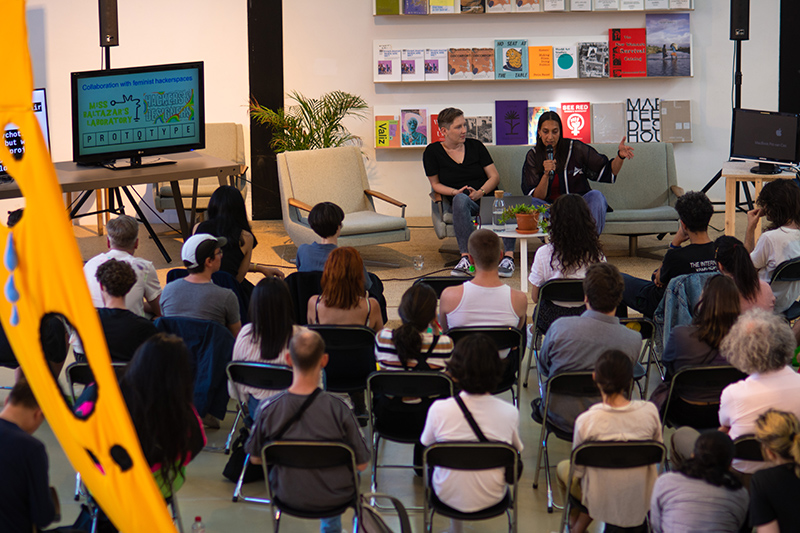
Due to the location of our studio at the NDSM, a diverse maker community of 100+ studios open to the public, we naturally gather visitors that are passing by, finding posters, flyer invitations, and an interactive display around our studio will help attract the attention to the series of public events. Furthermore our collaboration with The Hmm for the public events will help expand our network, we share a common pool of audience members, their network spans over 3 groups:
1. Creative participants
2. Curious Lurkers
3. Media, Communication, IT, and Art Students
We estimate an average of 20+ visitors for public events such as dinners, lunches, and the walk, 50-80+ for the Input Talks, and 200+ visitors throughout the final public event.
For the Summer Camp H&D develops a Communication Strategy consisting of:
Additional strategies to reach beyond a niche audience:
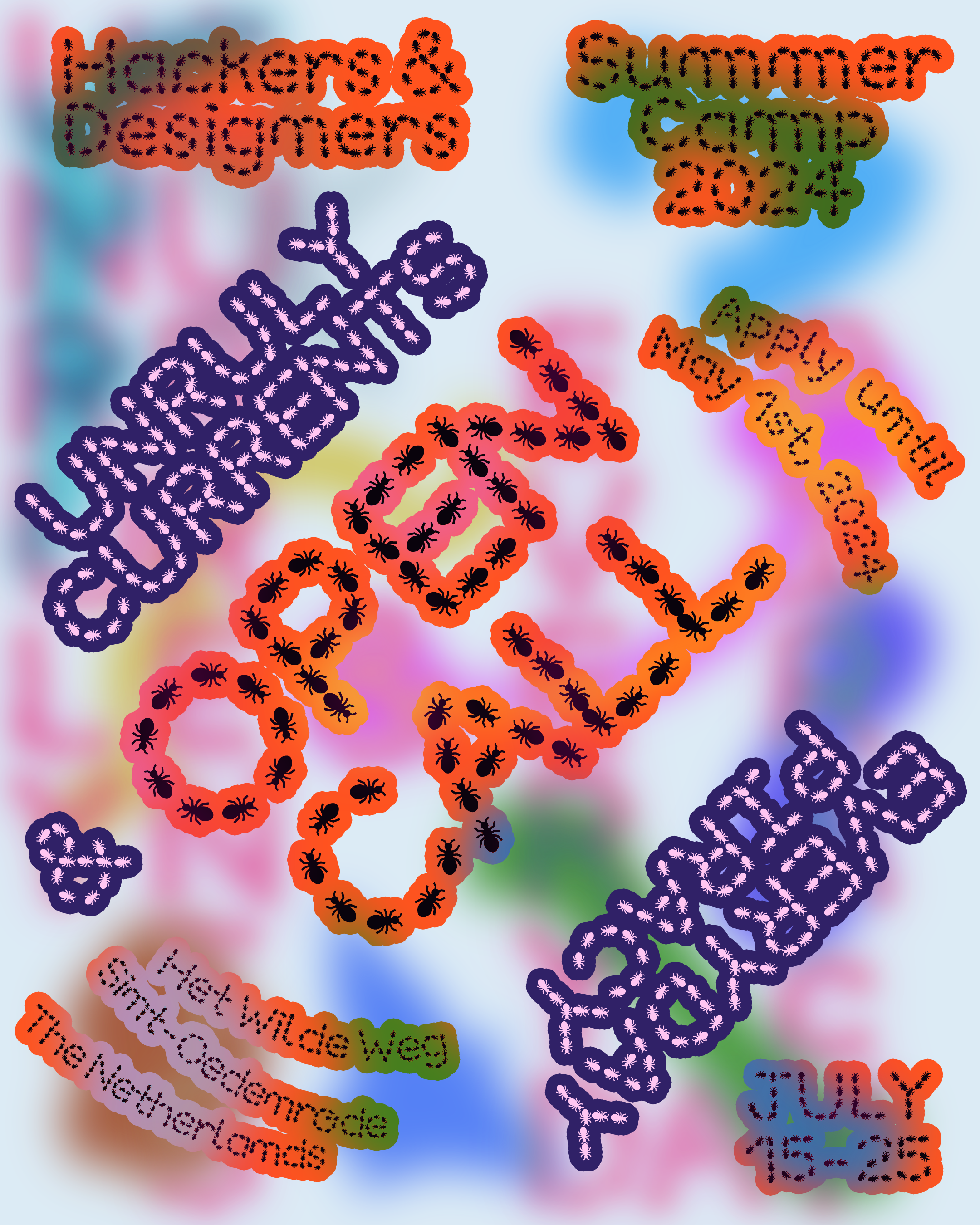
Every year we commission a designer to develop the visual identity for the summer program. Accessible, humorous and slightly ironic means of communication have been successful strategies for H&D to reach and connect diverse audiences. In 2022 we invited graphic designer Manon Bachelier, in 2023 Lukas Engelhardt and Sheona Turnbull, in 2024 Michael Fowler. It was successfully deployed on different support media, creating a strong and recognizable identity that has been positively perceived. For 2026 summer program H&D would like to build forth on our positive experience of working with designers from the H&D orbit inviting fanfare to contribute to the outspoken ‘H&D aesthetics’ as well as sharpening the choices we make (i.e. things like considering lower bandwidth in other parts of the world, making lightweight, privacy sensitive choices, making sites that are accessible for screen reader) in order to increase H&D’s visibility in the cultural field.
This visual campaign is shared through the following platforms and tools:
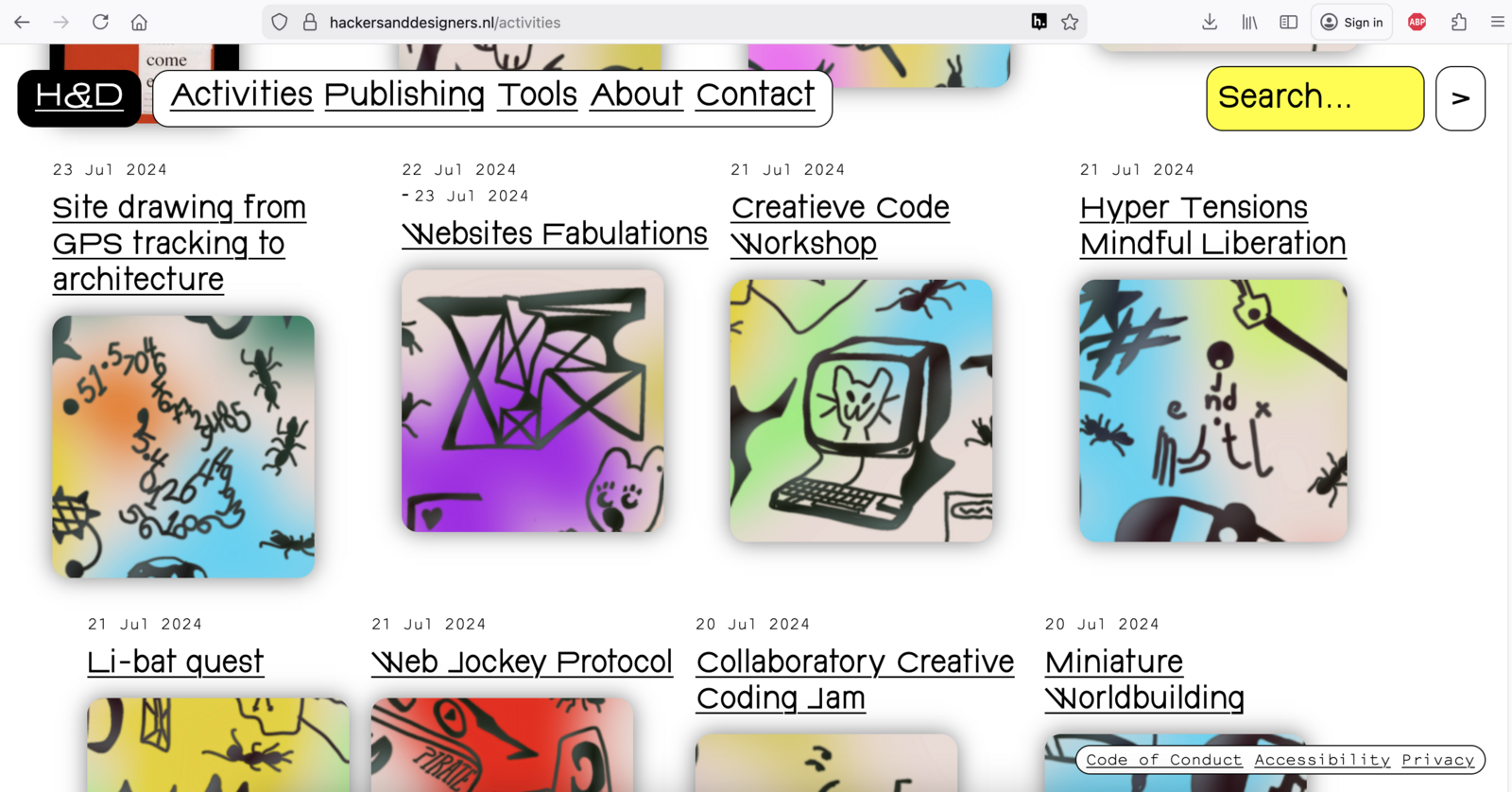
In 2024 H&D has launched a new website that takes web accessibility as well as sustainability as guiding principle, making it compliant with WCAG (Web Content Accessibility Guidelines) standards, more friendly towards assistive devices such as screen-readers, and minimizes bandwidths and loading times. We have furthermore implemented a multilingual feature, which allows events to be translated to Dutch and other languages when needed. Our website is the central communication reference point. We use the website to announce our open call for participation and list the full program of the Camp both participants only and public porgram. We publish workshop results, spin-off projects as well as code and tools that have been produced during The Summer Camp.
Our H&D mailing list is an open source, non-proprietary communication tool – and is used to announce upcoming events, share the open call for participation for the Summer Camp, for announcing the public program and follow up with documentation. We furthermore invest in sending out our Summer Camp open call through our network of collaborators.
H&D continuously explores experimental approaches to documentation, exploring different video and audio formats to report our activities and photo documentation.
Photographic documentation of the Summer Camp have proven to peak people’s interest, the daily sharing of a selection of photos on social media is keeping our target audience alert to upcoming public moments.
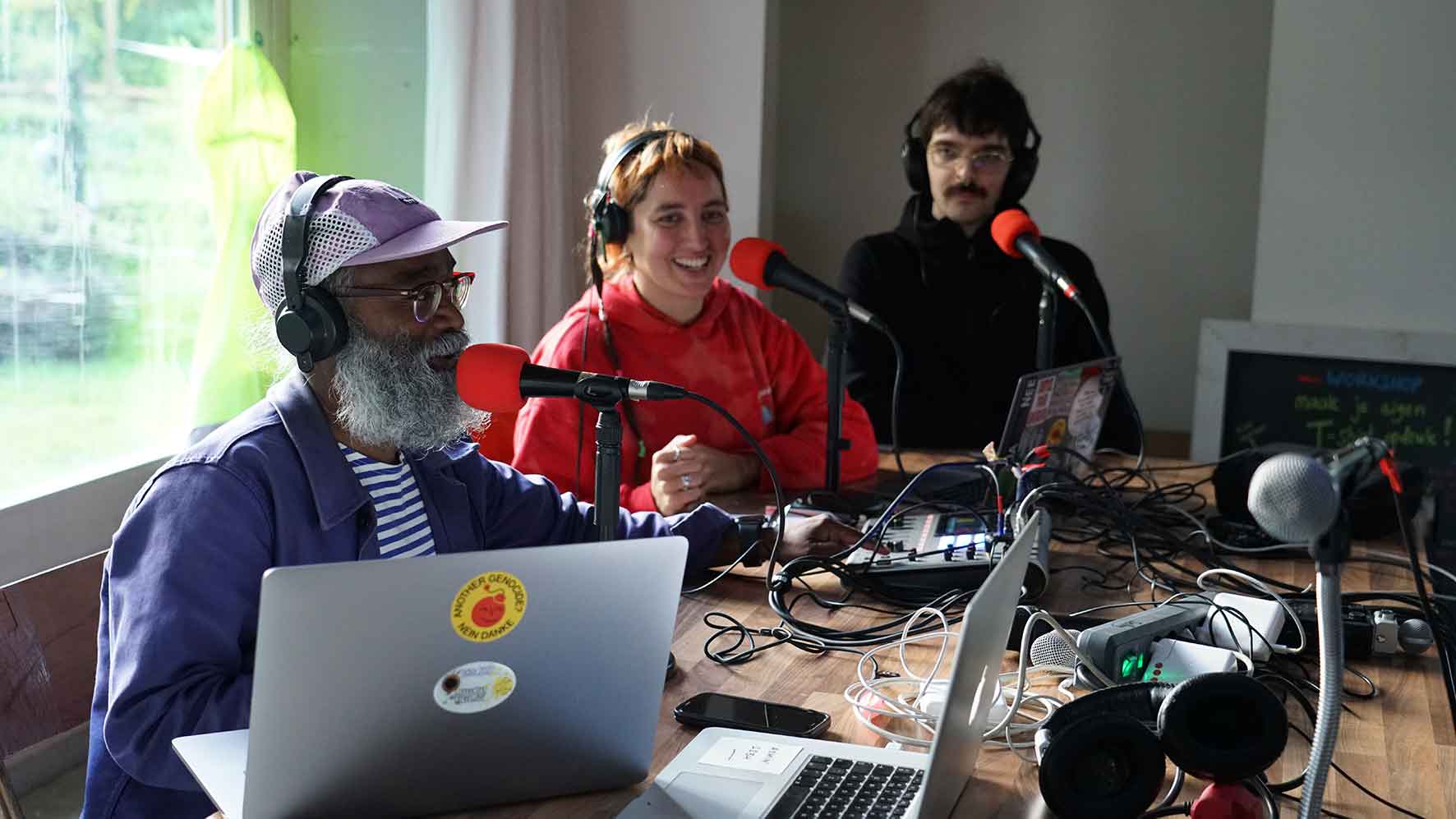
Our radio documentation has taken different turns through collaborations in the last years, working with collective Radio Echo for the Summer Academy of 2022, Benjamin Earl (Good Times Bad Times radio) during the Summer Camp of 2023 and self-organising for the Summer Camp in 2024 with a daily broadcast on our own livestream platform (upcycled from COVID times). The playful recurrent talk show format allows participants to reflect and report on the activities that took place. All shows are shared on SoundCloud and disseminated through the socials of H&D and all collaborators.
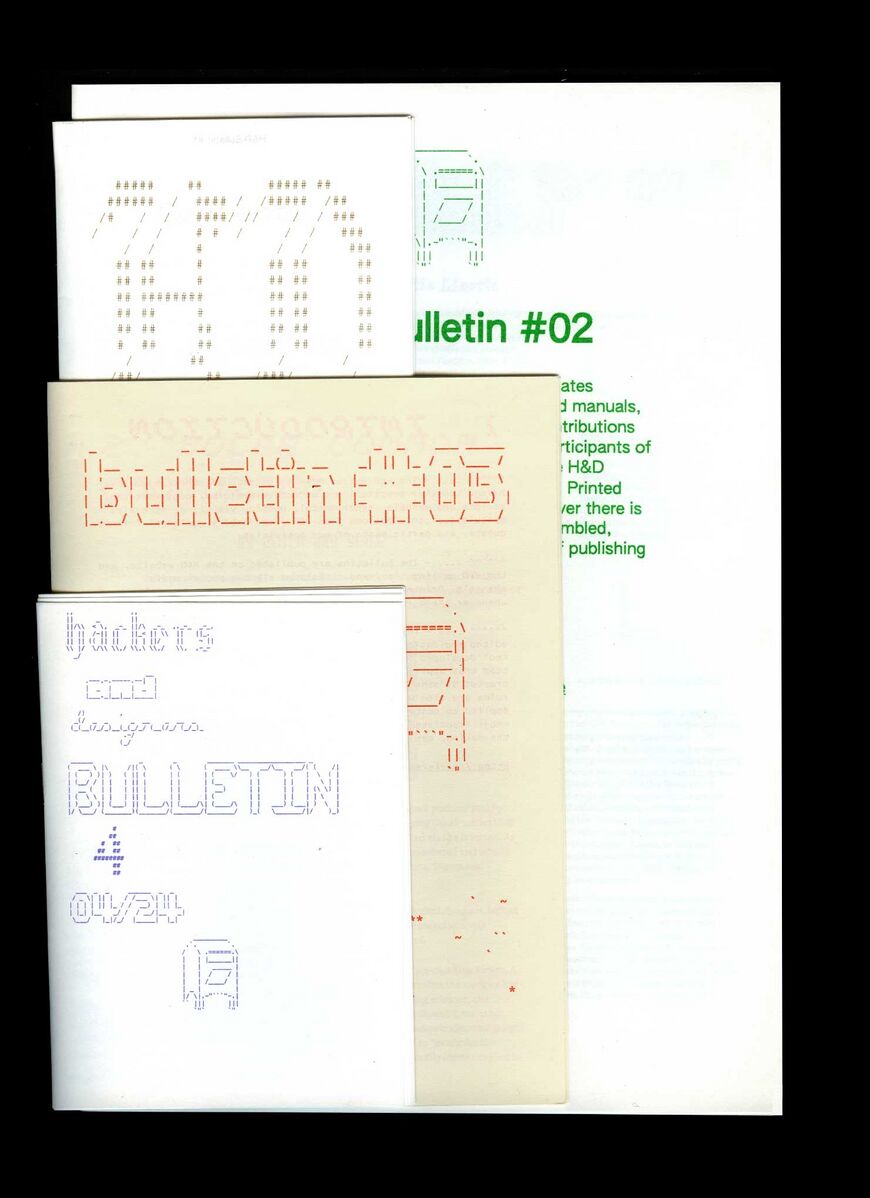
Every year we furthermore document our activities with a series of publications, which feature and reflect on activities developed throughout the year. Publishing as communication tool is a means to reconnect with collaborators and participants of our workshops, as well as attract interest for ongoing projects from untapped audience groups. It helps us build and stimulate a meaningful network of cross-disciplinary talent. Every year the publication is disseminated digitally and in printed form. In 2026 we will continue with this strategy with the publishing of a printed matter at the end of the Summer camp.
We are (still) present on Instagram (https://www.instagram.com/hackersanddesigners/), which remains the most relevant platform for us to publish our visual communication, gather and update followers.
We don’t use Facebook anymore, but kept our page to be able to be mentioned by partner institutes and organizations we collaborate with.
Alongside, we have been using Zulip, an open source self-hosted collaboration and communication tool for our internal and external communication and for expanding the H&D community through exchange on relevant topics and to promote events and workshops. Zulip is used as a central communication tool during our summer camp.
In the past years H&D’s has been solidifying its network internationally: H&D often travels abroad with a variety of collaborations, exhibitions, lectures, interventions and workshops. The interest of international collaborators helps to promote H&D’s values and practice of community organization, thinking through making and spreads the news for the H&D Summer Camp in an international setting.
Lectures and presentations when H&D is invited by other organisations and institutions attracts a wide audience and helps H&D raise visibility and acquire new participants for the summer camp. Many participants of the Summer Camp report having attended workshops or presentations of H&D before and felt excited by the approach as well as the visible queer friendliness of our programming.
H&D has been included in the Rewilding Cultures Mobility and Makery Network, who have published an interview about H&D before, and in the beginning of 2024 supported the dissemination of our Summer Camp Open call and offered different opportunities for mobility funds, which successfully funded six of our Summer camp participants. Makery commissioned artist and writer Lyndsey Walsh who joined for the 2nd half of the camp to reflect on the accessibility of the camp and write a review, increasing its reach.
Mailing list: 900 monthly readers
Website:
Instagram: H&D 5617 followers (+900 since last year)
Zulip: 208 users
Printrun of Bulletins #1-7: 1400 copies
Pirat(e)s Radio: 320 listeners
Total book distribution 2025: 250
The Hmm
hackersanddesigners.nl
wiki.hackersanddesigners.nl
www.instagram.com/hackersanddesigners
github.com/hackersanddesigners
git.hackersanddesigners.nl
The H&D network spans from European countries such as Austria, Belgium, Germany, France, Denmark, Romania, to countries across the globe such as Aotearoa (New Zealand), Armenia, Canada, China, South Korea, the USA, and Zimbabwe. Sister initiatives around the world contribute to H&D’s activities, including the annual H&D Summer Camp and international residencies.
H&D works with local and international established institutions like MU, SoundLab/Muziekgebouw aan t IJ, Constant Association for Art and Media, WAAG, Nieuwe Instituut, Institute of Network Cultures, GfZK Leipzig, Tetem, Dublin Science Gallery as well as emerging initiatives such as Prototype Pittsburgh, Mz* Baltazar’s Laboratory, Bergen Art Book Fair, Varia and The Hmm. These organizations help us to position our program and reach our target group directly.
H&D has developed from a spontaneously organized peer group who work voluntarily towards a mature 9-member decentralized organization, handling fair enumeration, undergoing regular evaluations and having developed a diverse financing mix. In recent years H&D has worked on transparency of our finances and governance structure. We hired a new accounting firm and intensified our collaboration to streamline our finances, which is now being handled by two more experienced coop members who have undergone additional financial training.
We continue to make efforts to develop further as a durable and healthy organization without giving up the unique character of H&D as a decentralized organization driven by the urgencies of its members and the wider community.
Although Hackers & Designers is legally constituted as a stichting, the organisation functions in practice according to cooperative principles. The ‘H&D COOP’ currently consists of nine members who form’ a decentralized organization that aims to distribute power over decision making. H&D operates locally in the Netherlands as well as internationally. Since 2019 H&D operates from a shared studio at the NDSM Loods in Amsterdam, which serves as our ‘headquarters,’ where we meet, develop workshops, and host guests and public programs.
The H&D COOP members at the time of submitting this application are:
Public Program Collaborator
Location Collaborator
Guests Public Program
Learning Palestine is a group of artists, academics, intellectuals and community members, who aim to disseminate knowledge on the history of the ongoing struggle for justice, liberation, and freedom of Palestine and the Palestinian People. They wish to practice new and old ways of disseminating this knowledge, that function out with the constrains of social media and corporate controlled networks. H&D’s recent collaboration with Learning Palestine on building an alternative publishing infrastructure with them highlights the different concerns and stakes involved in self-hosting in the context of self-publishing and political activism, and highlighted the unique challenges when such tools are deployed in a specific context. https://learningpalestine.net/ —in conversation
Marloes de Valk is a software artist and writer in the post-despair stage of coping with the threat of global warming and being spied on by the devices surrounding her. Surprised by the obsessive dedication with which we, even post-Snowden, share intimate details about ourselves to an often not too clearly defined group of others, astounded by the deafening noise we generate while socializing with the technology around us, she is looking to better understand why. —in conversation
Sondi is an artist and researcher from Germany born in Cameroon and based in the Netherlands. Her practice centers on worldbuilding and worlding particularly within digital spaces and video games. She examines how power and narratives operate within virtual environments tracing encoded biases algorithmic discrimination game mechanics and the portrayal of people places and ecologies while crafting worlds that foreground marginalised voices and perspectives often excluded from our techno-futures. https://www.sondi.online/info —in conversation
Lukas Engelhard is a graphic designer and artist mostly based in Amsterdam and online working with autonomous infrastructures, online as well as offline and trying to understand the tactics, terms and conditions necessary to negotiate and maintain them. He builds, breaks and fixes servers for himself and for others and is active in the housing struggle. https://lukasengelhardt.net/ —in conversation
Bart Stuart & Klaar van der Lippe have been working as a duo since 2005, based at the NDSM Wharf in Amsterdam. They work with ideas rather than objects and aim to think about social processes in a visual way. From an independent, critical position, they try to initiate a dialogue between different disciplines and ways of thinking—about art, money, and idealism. They actively participate in the public debate on authorship and the city. https://bartklaar.hotglue.me —in conversation
Robin Food Kollektief is a community kitchen initiative that cooks with zero waste salvaged food items https://robinfoodkollektief.nl/ —in conversation
Leanne Wijnsma runs the design studio yeast.computer. The studio builds experiences for the senses using smells, soil and microbes, making technology tactile. Their work is about communicating the importance of the invisible. yeast.computer also organizes workshops and gives lectures on instinctive interfaces and prototyping future senses. https://yeast.computer/ —in conversation
Kimberley Cosmilla Through variying methods but consistent use of narration, Kimberley’s work questions collective processes in the publishing context, dissemination techniques, and vernacular archiving methods. Mostly operating in collective contexts (group shows, workshops, collective editorials) where designing represents an opportunity to experiment with collective agency rather than a goal to produce a “good design”, she often undertakes the role of the facilitator. Her work may take the form of role-plays where these metaphors are dissected, and where participants are instructed to contribute to a script and/or a design template. The playful scenarios or real-life situations she elaborates intend to lead to tangible results as well: The publishing of a zine, an art publication, a collective decision, a collectively curated cultural space, a dinner, etc. —confirmed
Lumbung Practice (Temporary Master Sandberg Instituut) builds on the gained knowledge and experimentations in lumbung-documenta fifteen. It gathers individuals working in a collective, a community or in other forms of the commons. Participating collectives spent the last 2 years practicing and learning about lumbung, self-organization, and sociopolitical artistic and curatorial practice, as well as producing alternative art institutions and economies for the future. https://sandberg.nl/temporary-program-lumbung-practice —in conversation
Humdrum Press is a experimental publishing imprint and expanded publishing practice that works, through collaborative means, to question the boundaries of “publishing” – publishing here understood as praxis, methodology, physical outcome, artistic & design practice, and research discipline – and experiment with developing more horizontal, sustainable, and public models of publishing. In doing so, HumDrum Press wishes to explore new, connected ways of documenting and disseminating voices, ideas, and contexts, and better understand the role of publishing and publisher within current political, economic, and ecological climates. https://humdrumpress.com/ —confirmed
Martine Neddam is an artist based in Amsterdam who initiated the project Mouchette, an interactive website created in 1996 by a virtual person, a pseudonymous character, an Amsterdam based artist calling herself Mouchette. While the use of taboo subject matters are what initially provokes heated reactions, the manipulation of cyber-identity and the ability of the creator to maintain anonymity for so long are the significant reasons this website has garnered its international reputation in the internet art community. Neddam is translating her Mouchette project to a chat version, based on all the data that she collected over the past years. https://www.neddam.info/ —to be invited by The Hmm
Daniel de Zeeuw is assistant professor in digital media culture at the University of Amsterdam. He is currently writing a book on how information has been imagined and instrumentalized as a force. Daniel wrote an article about Psyop Realism: a new online style that reflects how it feels to live in a world of constant manipulation, misinformation, and targeted influence. —to be invited by The Hmm
Visual Identity Collaborator
Publishing Collaborators
nokiss Based in Amsterdam with a focus on book design and self publishing, no kiss prints and binds, for various organisations and individuals that work in the cultural field. Besides printing and binding no kiss guides the whole bookmaking process from start to finish. https://no-kiss.com/ —in conversation
OUTLINE is a publishing platform for printed, sonic and ephemeral matter based in Amsterdam. We aim to facilitate an exchange by making use of expanded publishing and remixing methods to connect ideas, materials and localities, embracing a scene-based and relational approach. https://outline-platform.com/ —in conversation
To adhere to fair remuneration guidelines and inflation, our hourly fee is €65 ex VAT in 2026.
We are asking 17 500e to AFK to produce our Summer Camp. From 2015 to 2024 we received structural funding from Stimuleringsfonds which supported the organisation of our yearly program including the Summer Camp. We would co-finance with AFK. In 2024, despite a positive advice we didn’t receive the 2-year activity grant from Stimuleringsfonds, resulting to not being able to find another way to organise our annual Summer program in 2025. The support of AFK would allow us to make a new iteration of a successful and relevant program.
The budget is partially co-financed by The Hmm who is a financial and curatorial partner. Our studios are located next to each other and connected, within NDSM, allowing to host workshops and some of the public program, a part of the rent of the studio is covered by both our budgets. Because we are part of the NDSM we get access to other locations within the warehouse such as the Theater.
Our own contribution corresponds to hours that we can cover from our internal budget, we operate at minimum capacity at the moment but still have income from invitations and collaborations that get redistributed for collective work. Hackers & Designers is part of the Connecting Otherwise research project of Sandberg and Rietveld funded by SIA and Stimuleringsfonds. Members of H&D are involved in research groups focusing on small file media as well as alternative publishing tools, which contribute to Research & Development for the Summer Camp as well.
We expect income from participants. The participation to the full Summer Camp will be based on a sliding scale from 150 to 300, to be determined by applicants based on their financial abilities. 3 full bursary will be proposed. Public program will have an entrance fee of 5euros for talks and the walk, a sliding scale of 10-20 euros for lunches and dinners with talks, some spots will be reserved for free on demand.