A series of texts republished by Learning Palestine group.
Volume 2, Pamphlet 5/10 - 2025 (#30)
Original text is in Critical Times (2024) 7 (1): 94–109. https://doi.org/10.1215/26410478-11082977
We are (re)publishing these texts to disseminate knowledge on the history and present-day struggles for justice and liberation for Palestine and the Palestinian people. We thank the authors who gave us permission to (re)publish their texts, and gratitude to those whose texts we used without seeking permission. We believe that these works ought to be read, circulated and acted upon urgently, as the genocidal war on Palestine continues unabated. The pamphlets* are meant to contribute to historical and political literacy for liberation in the service of the people. What is knowledge for if not to change the world to a just place for all?
To be involved in the efforts of Learning Palestine: learningpalestine.net
The word pamphlet originates from the 12th-century Latin love poem ‘Pamphilus, seu de Amore’. Pamphilus, or ‘concerning love’ is derived from the Greek name Πάμφιλος, meaning ‘beloved of all’. The popular poem formed a slim codex and was copied and circulated widely. *These pamphlets are not meant to be used/circulated for commercial purposes.
A poem, a text and another poem
June Jordan
Everything that goes into the zine
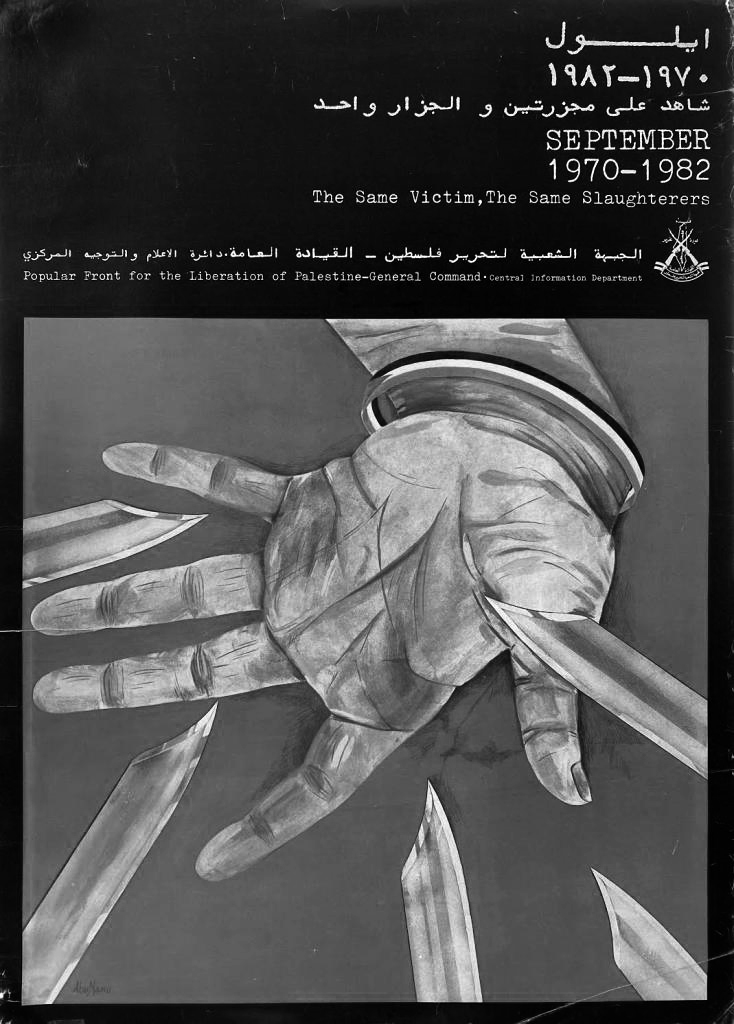
Abu Manu, 1982, Popular Front for the Liberation of Palestine - General Command
Apologies to Alll the People in Lebanon
- Dedicated to the 600,000 Palestinian men, women, and children who lived in Lebanon from 1948-1983. *
I didn’t know and nobody told me and what could I do or say, anyway? They said you shot the London Ambassador and when that wasn’t true they said so what They said you shelled their northern villages and when U.N. forces reported that was not true because your side of the cease-fire was holding since more than a year before they said so what They said they wanted simply to carve a 25 mile buffer zone and then they ravaged your water supplies your electricity your hospitals your schools your highways and byways all the way north to Beirut because they said this was their quest for peace They blew up your homes and demolished the grocery stores and blocked the Red Cross and took away doctors to jail and they cluster-bombed girls and boys whose bodies swelled purple and black into twice the original size and tore the buttocks from a four month old baby and then they said this was brilliant military accomplishment and this was done they said in the name of self-defense they said that is the noblest concept of mankind isn’t that obvious? They said something about never again and then they made close to one million human beings homeless in less than three weeks and they killed or maimed 40,000 of your men and your women and your children
But I didn’t know and nobody told me and what could I do or say, anyway?
They said they were victims. They said you were Arabs. They called your apartments and gardens guerrilla strongholds. They called the screaming devastation that they created the rubble. Then they told you to leave, didn’t they?
Didn’t you read the leaflets that they dropped from their hotshot fighter jets? They told you to go. One hundred and thirty-five thousand Palestinians in Beirut and why didn’t you take the hint? Go! There was the Mediterranean: You could walk into the water and stay there. What was the problem?
I didn’t know and nobody told me and what could I do or say, anyway?
Yes, I did know it was the money I earned as a poet that paid for the bombs and the planes and the tanks that they used to massacre your family
But I am not an evil person The people of my country aren’t so bad
You can expect but so much from those of us who have to pay taxes and watch American TV
You see my point;
I’m sorry. I really am sorry.
Life After Lebanon
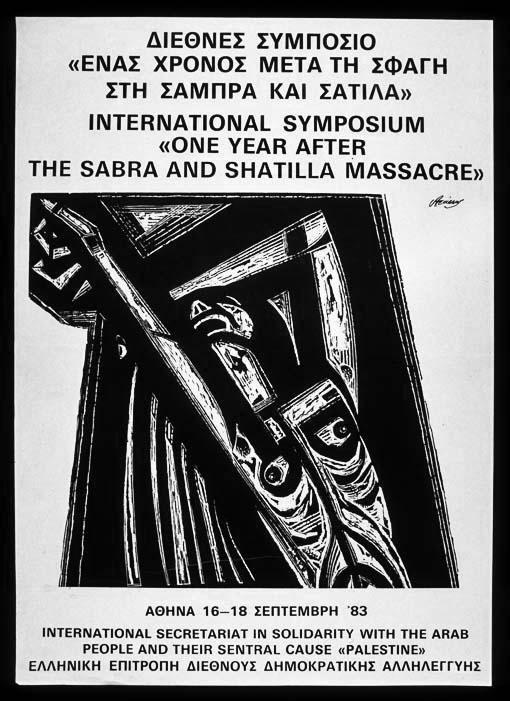
A. Traissos, 1983, International Secretariat in Solidarity with the Arab People and Their Central Cause - Palestine
LET ME JUST SAY, at once: I am not now nor have I ever been a whiteman. L And, leaving aside the joys of unearned privilege, this leaves me feeling pretty good: I am glad I am not the whiteman who warns that Nicaragua is next on his evil list and who, meanwhile, starves and terrorizes that country through “covert action.” I am glad I am not the whiteman who congratulates El Salvador and who supports South Africa. I am glad I am not the whiteman who lies about Managua and who denies asylum to real freedom fighters opposed to Pretoria. I am glad I am not the whiteman who dyes his hair, wears pancake makeup, and then tries to act like the last cowboy out here surrounded by wild Indians. I am glad I am not the whiteman whose poor little help meet used to sleep beside him with a pistol (albeit an expensive, delicate, and ladylike pistol) under her pillow. I am glad I am not the whiteman whose wife publicly saw fit to call another woman a bitch. Or, more precisely, to call another woman a term rhyming with rich. (Evidently this means that the language of the latrine becomes acceptable and, better yet, properly female, if you intimate and euphemize your infamies.) I am glad I am not the whiteman who thinks it’s Old Boy Manly to describe his debate with the Democratic candidate for Vice President of the United States as “kicking a little ass.” I am glad I am not the whiteman who advised Geraldine Ferrarro to pretend she’s actually another whiteman: to look dull, act calm, or to just generally let the lies and insults roll, without appropriate, emotional, and justified retaliation. I am very glad that I am not a single one of the several, very powerful whitemen who, in their American manliness, have failed, out- standingly failed, to defend Geraldine Ferrarro from unjust, undue, and obnoxious harassment, such as not one of them has ever had to confront:1 What do you suppose would happen if a Soviet leader, after meeting with Ronald Reagan, and after returning to Moscow, repo rted in this fashion on those talks: “Oh well, I kicked a little ass.”? I see all of this as what I will summarize as The New Manliness. Craven and cowardly by its nature, these North American machos absolutely abhor the fair fight, the face to face argument between equals and, instead, preoccupy themselves with a relentless assault upon those who are indisputably smaller and weaker than they. In the world of these New Men, you do not turn to Daddy when you need help because Daddy’s busy beating up Mommy and, if he notices you standing around, he may very well hurl your nine-year-old torso against the dining room wall. These New Men follow a rather cross-eyed vision of Far West mythology. No longer does The New Man pit himself against much greater odds than he can ever see—pestilence, drought, outlaw bands of cattle thieves, and corporate encroachment upon his lands. Instead, he preys upon his wife, his children, his Black coworker, the poor, the elderly, Grenada, Nicaragua, and he boasts about it— if not at the neighborhood bar, then at a full scale press conference held at The Big House. When I refer to the New Man, I am not speaking about someone with natural tendencies to batter or oppress. I do not mean that all whitemen are reducible to their color or their gender. The New Man is someone who maintains a system of unequal power relations in order to preserve his own domination. And he is willing to do this at any cost. This is why a woman is battered every fifteen seconds in this country, and this is why Geraldine Ferrarro has been the target for unprecedented, unequal abuse, and this is why every developing nation on the planet must sweat to secure its sovereign rights of independent ways and means away from the depradations of these New Men in the poisonous bloom of their New Manliness. This is why Jesse Jackson, unarguably the presidential candidate with the least resources available to him, was the candidate most vilified, most ridiculed and, despite his having delivered six million new registered voters to the Democratic Party, was the most abandoned by the leaders of the Democrats, and the most humiliated by the Democrats who have rejected everything and everyone he, Jesse Jackson, so eloquently represented. And, like Geraldine Ferrarro, the Reverend Jesse Jackson has been bullied into gestures conciliatory towards his enemies; his enemies have pushed him into postures that none of them would ever think to adopt: Who has demanded that Ronald Reagan repudiate Jerry Falwell or Jesse Helms?2 When have you ever seen Ronald Reagan or Walter Mondale ask the people of this country to forgive him?
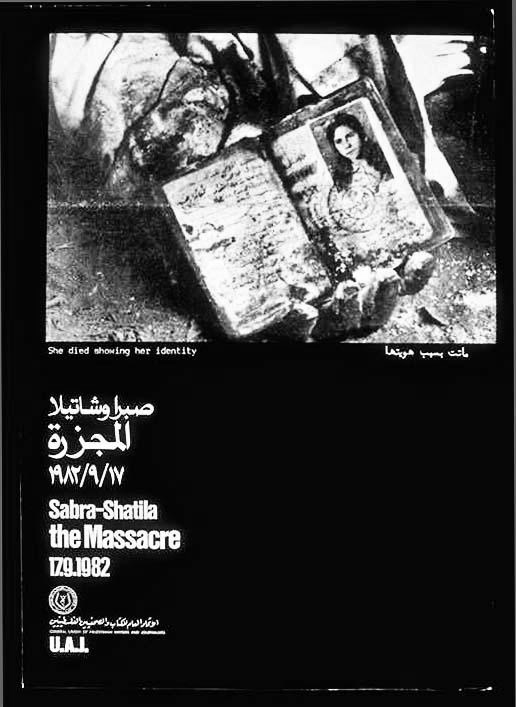
Marc Rudin, Jihad Mansour, 1982, Union of Arab Journalists
And can you recall any whiteman, can you imagine any whiteman, ever saying to you, “Be patient with me; God has not finished with me yet”?3 And yet, on record, what are the crimes of Jesse Jackson, for which he should ask forgiveness? Show me the dead, the hungry, the desolate, the subverted, the bombed out, the burned up; show me evidence of his wrongdoing. Who is the whiteman, anywhere, to whom the Reverend Jackson should apologize? This cross-eyed New Manliness of North America explains why the ostensible great threat is another Big Guy, the Soviet Union, and yet it is not the Big Guy’s actual property that the United States will invade, it is not Soviet waters that the United States will mine. It is some other country, some small, some weak, some non-white country allegedly under Soviet influence that The New Men of the USA will choose to torture and destroy—rather than face another whiteman who just might kick his ass, a little bit. The New Men of the USA madly develop abstract systems for nuclear annihilation because that will mean that at least they didn’t “lose” simply because nobody can win that showdown. So I am glad, I am truly glad that I am not now, nor have I ever been, a whiteman. But where does all of this happiness, this relief, put me, exactly? I must think about the woman who was interviewed on TV, immediately following the Bush-Ferrarro debate. She said she would vote for Reagan because she would feel “safe” with a man. Like George Bush. And I cannot overlook the woman quoted in today’s press; she said she felt good about Geraldine because Geraldine “stayed calm.” Given the near-hysterical nastiness of much of what came out of his mouth, given the obvious misogyny and the scorn that determined his behavior towards his opponent, and given the merciless and warmongering policies of his administration to date, I must conclude that that woman would feel safe only because George Bush is not a woman. She knows that no woman is safe in this man’s world, and that no woman, so far, has been able to create and assure safety for herself, and other women, in this man’s world. She spoke, in other words, from the desperation that a realistic understanding of gender politics will yield. But she was speaking against the one instance in our history, the instance of Geraldine Ferrarro, when a woman might accede to a position of enough power so that she could begin to design and establish safety for herself, and for other women. That woman who spoke against Geraldine Ferrarro, hers was a failure of faith tantamount to capitulation: However understandable, hers was an act of self-hatred. The other woman, the one who seemed pleased by Ferrarro’s staying “calm” seems to me related: Unless you accept white male standards of conduct, standards that castigate women for our “emotionality,” our tears, our tendencies to take human life and responsible love quite seriously, why would you applaud any woman for remaining “calm” in an outrageous circumstance? What would be the reason to fault Ferrarro for becoming furious, indignant, disgusted, and thoroughly impassioned, as she righteously reacted to the lies and the self-absorbed and morbid and patronizing complacencies of Mr. George Bush? But while I must think of these two women, and I must wonder when they will ever identify self-respect as a reasonable goal that we can join together to approach, there are many, many other women, in this country, and around the world, who are not now, nor have they ever been whitemen: Women who are making over this place of ours into a place of safety for all of us, including white men. The values and the methods of these women, women completely uninterested in keeping calm, women entirely prepared to make a scene, to raise a ruckus and to be shrill, if you will, these women I may describe to you as New Women. Two years ago it was a Jewish woman who first alerted me to the Israeli invasion of Lebanon, and to the issues of that horrendous episode in our history: territorial integrity, the survival of the Palestinian people, facts versus propaganda, self-determination versus neocolonialism, and American taxes—my and your money—providing the Israeli armed forces with means to carry out this invasion of another country. It was an Israeli woman who informed me about the Peace Now movement inside Israel, a movement opposed to the invasion, and opposed to the massacre
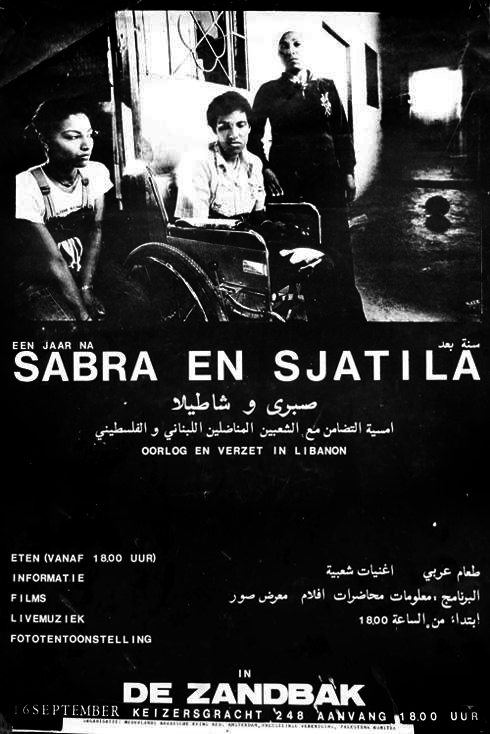
Unknown artist, 1983, Netherlands Palestine `Committee
of the Palestinian people. It was an Israeli woman who warned me that the ulterior purpose of the invasion was Israeli settlement of the West Bank, i.e. complete displacement and disenfranchisement of the Palestinian people. During the summer of 1982, it was another Jewish woman with whom I spoke daily, comparing newspaper and radio accounts, tracking eyewitnesses recently returned from Lebanon, and planning whatever we could to counter the lies that saturated the U.S. media; we wanted to stop the war. The other people with whom I kept my witness, and wept, and worked, that summer, were, again, mostly women, and mostly Jewish women. For a long time I believe that we supposed the problem was that of misinformation. If only Americans knew the truth of things then they would rally to help, to stop the invasion, the slaughter. What I gradually began to understand, however, was something importantly different. The problem was that the Lebanese people, in general, and that the Palestinian people, in particular, are not whitemen: They never have been whitemen. Hence they were and they are only Arabs, or terrorists, or animals. Certainly they were not men and women and children; certainly they were not human beings with rights remotely comparable to the rights of whitemen, the rights of a nation of whitemen. In addition, I learned as a result of a poem I wrote that was published in July 1982, in The Village Voice, and I learned as a result of all of the op-ed pieces of mine that the New York Times unabashedly refused to print, that no women and that certainly no non-white woman should presume to think about/form an opinion/construct an analysis of any issue of conflict between any whitemen. Either the whitemen in this country will censor and block the publication of such a woman’s thoughts, or they will whitelist and pounce upon her with such epithets as “anti-Semitic” and “naive” and “divisive.” In the fall of 1982, myself and two other women met at my house to discuss what else we might attempt. This was immediately prior to the massacre of Sabra and Shatilah. We decided to convene a poetry reading in which North American poets, Israeli poets, and Arab poets would combine their poetry inside an event to benefit the children of Lebanon: All monies raised by the reading would go directly to UNICEF, for the maimed and homeless children victimized by the invasion. After much toil, the other two women, both of them young white poets, and one of them Jewish, succeeded in organizing an historic poetry reading in which, indeed, Israeli, Arab, and American poets literally agreed to appear on the same stage on the same night. As it happens, I was the last poet to read, that evening. When I finished, I found myself surrounded by large whitemen, two of them Israeli poets, all of them yelling at me and threatening me with the looming bulk of their bodies. It was women who got me out of that auditorium. It was women, one of them Black, one of them Jewish, one of them WASP, who watched out for me, and who “covered my back” at the reception following, a reception at which one whiteman told a young Jewish woman that I, “That Black woman over there should be burned alive in green fire.” It is noteworthy that this particular whiteman did not say this directly to me. Nor did he address his vile remarks to my son who was standing not more than three feet away from him, and who would have cheerfully punched out his lights, so to speak. It is noteworthy that not one white man, Israeli or otherwise, said anything to me, directly, except when he stood as part of a group of whitemen hugely outnumbering me. But what I find more memorable are the women of that summer and of that November evening, 1982: The New Women of the New Womanliness who persisted against the male white rhetoric about borders and national security and terrorism and democracy and vital interests. And I also find memorable the distinguished U.S. Congressman, John Conyers, who nobly em-ceed that benefit poetry reading, and who hosted the reception afterwards: John Conyers is not now, nor has he ever been, a whiteman. The Israeli invasion of Lebanon, the complicity of Americans through tax monies that supported the invasion, the slaughter of Lebanese peoples, the decimation and rout of the Palestinian peoples, the awesome determination by whitemen, in this country, to silence or to discredit American dissent, the vicious wielding about of the term anti-Semitic whenever anyone protested the interminable carnage executed and precipitated by that invasion, left me extremely embittered, shocked, and wondering about life after Lebanon: What would that be like? In fact, the intellectual community, including the feminist community of North America, and the entire community of the political left in America separated into two seemingly irreconcilable groups, at a minimum: There were those for whom Israel remained a sacrosanct subject exempt from rational discussion and dispute, and there were those to whom Israel looked a whole lot like yet another country run by whitemen whose militarism tended to produce racist consequences; i.e. the disenfranchisement and subjugation of non-white peoples, peoples not nearly as strong as they. Now it is one thing to disagree and quite another to prohibit disagreement. The invasion of Lebanon erected a subject off-limits to disagreement. The only supposedly legitimate persons allowed by the media to express any views whatsoever on Lebanon/Israel/Palestinians/U.S.-Middle-East policies were whitemen. Everyone else was either an Arab (i.e. “Anti-Semitic”) or “Anti-Semitic,” or else “self-hating Jews” (i.e. “Anti-Semitic”). With the construction of an ultimate taboo, a taboo behind which the fate of an entire people, the Palestinians, might be erased, how could there be an
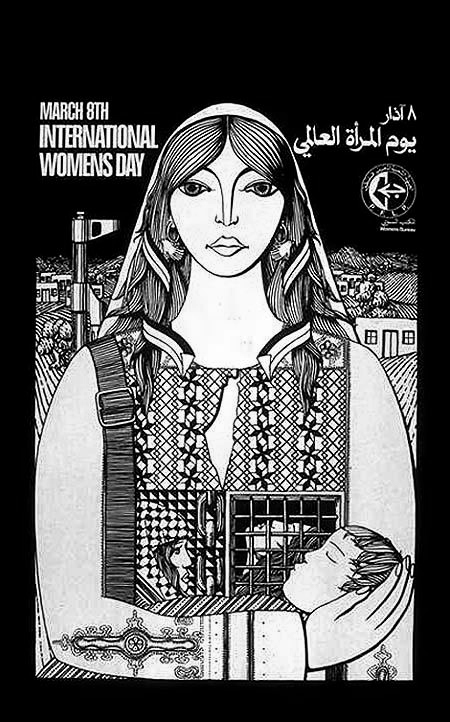
Marc Rudin, Jihad Mansour, 1980, PFLP
intellectual, a moral life after Lebanon in this country? I would have to answer my own question in this way: Because many people in the United States and around the globe are not now nor have they ever been whitemen. Many of these people are Black—one of whom tried to become President of our country. Many of these people are Jewish women who never quit from sending out flyers and making phone calls. Many of these people are male and female Jewish lawyers who are now personally threatened by new Reagan legislation intended to eliminate basic freedoms of dissent. Many of these people are young white women and young whitemen who do not want to grow up guilty of killing other people who have never hurt them. Many of these people are Black women and white women who perceive that the ambitions of self respect and species’ survival reveal deeply indistinguishable values. Here and in South Africa and in Nicaragua and in Amsterdam and in England I see a New Woman: She frequently wears a uniform. She often carries a gun. She puts down her body to block missiles and bullets, alike. She grieves for the dead but she fights back, to honor the dead. She learns self- defense. She runs for public office. She earns positions of enormous political power. And she is not calm. She is very excited and very busy making over this place into a safe place for us all, including whitemen. She is Fannie Lou Hamer and Geraldine Ferrarro. She is Barbara Masakela and Winnie Mandela. She is Vivian Stromberg of Mobilization for Survival. She is Kathy Engel and Alexis De Veaux of MADRE. She is Carol Haddad who founded the Arab-American Women’s Feminist League. She is Gail Jackson and Paula Finn of Art Against Apartheid. She is Sara Miles of Talking Nicaragua and The International Brigades to Nicaragua. She is Betsy Cohn who founded The Central American Historical Institute in Washington. She is Frances Fox Piven who co-founded The Human Serve Voter Registration movement that may permanently alter the composition of our electorate. She is Etel Adnan, the visionary, great Lebanese poet who has written, in her transcendant, miraculous novel, Sitt-Marie Rose: On the wall there is a crucifix. But, in this room, Christ is a tribal prince. He leads to nothing but ruin. One is never right to invoke him in such circumstances, because the true Christ only exists when one stands up to one’s own brothers to defend the Stranger. As a child I was taught that to tell the truth was often painful. As an adult I have learned that not to tell the truth is more painful, and that the fear of telling the truth—whatever the truth may be—that fear is the most painful sensation of a moral life. In my own life after Lebanon it has been other women who have helped me to outlive and to undo my fears of telling the truth. It is other women, the New Women among us, who have helped me to see what the headlines and the powerful who seek to divide us try to obscure and obliterate. And I keep hearing about anti-Semitism. I read about Blacks and Jews at “each other’s throats.” I am buffeted about by news of phony freedom fighters and savage “victories” and “spheres of influence” and “implacable” ethnic and ideological and class differences inevitably exploding to consume the earth. But what I see for myself is New Women everywhere in the world discovering each other with a happiness and a resolute purpose of survival that will surpass all the weird and fatal bewitcheries of traditional power, traditional insanities of conflict. What I know from my own life after Lebanon is that I must insist upon my own truth and my own love, especially when that truth and that love will carry me across the borders of my own tribe, or I will wither in the narrow cold light of my own eyes. As Etel Adnan has written: It is when we women, The New Women of the world, “Stand up to our brothers to defend the Stranger,” it is only then that we can hope to become innocent of the evil that now imperils the planet. It is only then, when we cease worshipping the tribe, that we will find our way into a tenable family of men and women as large and as invincible as infinite, infinitely varied, life.
Moving Towards Home
- “Where is Abu Fadi,” she wailed. ” Who will bring me my loved one?”
- The New York Times, 9/20/1982 *
I do not wish to speak about the bulldozer and the red dirt not quite covering all of the arms and legs Nor do I wish to speak about the nightlong screams that reached the observation posts where soldiers lounged about Nor do I wish to speak about the woman who shoved her baby into the stranger’s hands before she was led away Nor do I wish to speak about the father whose sons were shot through the head while they slit his own throat before the eyes of his wife Nor do I wish to speak about the army that lit continuous flares into the darkness so that the others could see the backs of their victims lined against the wall Nor do I wish to speak about the piled up bodies and the stench that will not float Nor do I wish to speak about the nurse again and again raped before they murdered her on the hospital floor Nor do I wish to speak about the rattling bullets that did not halt on that keening trajectory Nor do I wish to speak about the pounding on the doors and the breaking of windows and the hauling of families into the world of the dead I do not wish to speak about the bulldozer and the red dirt not quite covering all of the arms and legs because I do not wish to speak about unspeakable events that must follow from those who dare “to purify” a people those who dare “to exterminate” a people those who dare to describe human beings as “beasts with two legs” those who dare “to mop up” “to tighten the noose” “to step up the military pressure” “to ring around” civilian streets with tanks those who dare to close the universities to abolish the press to kill the elected representatives of the people who refuse to be purified those are the ones from whom we must redeem the words of our beginning
because I need to speak about home I need to speak about living room where the land is not bullied and beaten to a tombstone I need to speak about living room where the talk will take place in my language I need to speak about living room where my children will grow without horror I need to speak about living room where the men of my family between the ages of six and sixty-five are not marched into a roundup that leads to the grave I need to talk about living room where I can sit without grief without wailing aloud for my loved ones where I must not ask where is Abu Fadi because he will be there beside me I need to talk about living room because I need to talk about home
I was born a Black woman and now I am become a Palestinian against the relentless laughter of evil there is less and less living room and where are my loved ones?
It is time to make our way home.