| itle: Serious Play Class 6: Family Matters |
| anguage: en |
GROUP NAME / GAME TITLE
Date: Round 1 Secretary: Round 2 Secretary: Round 3 Secretary: Round 4 Secretary: Round 5 Secretary: Round 6 Secretary:
Notes from the game building class in the Serious Play workshop in KABK 2026
1. Landing the Game in Theory (60 min)
1.1. Core Question / Problem What is the main tension or problem your game is about? nuclear vs non-tradional family formation(alternatives to nuclear family)!! Which real institution/structure is it an allegory of (healthcare, family, education, etc.)? FAMILY CREATION / QUEER FAMILY (In queer communities, this process happens constantly in real life - people literally n egotiate what family means, what care means, what fidelity means, because there are no ready-made answers. The nuclear family provides a fixed template. The queer extended family reinvents it every time.)
victim - perpetrator - witness
    resources cards needed ?

        based on the question and tension

            unconditional love can be translated into attention
            currency of guilt
            dissect, deconstruct currencies and exchanges
            socially imposed roles
            inheritance
CARDS FOR: SITUATIONS - ROLES - PHASES - NEEDS - OBJECTS -
NEXT WEEK WORK DIVISION:
1.2. Theoretical Anchors Federico Campagna’s Prophetic Culture: Recreation for Adolescents (2021) :3 Donna Haraway - make kin not babies (chapter 4 from stayoing with the trouble(s?)) - In order to survive we have to rethink the ties of kinship. Who is your relative? judith butler - gender trouble deleuze and guattari - anti-edip
How do these ideas show up inside the game (as rules, roles, conflicts, rituals)? the 2 roles (child(community) - parent(individual)) the child is the one choosing their parent
resources: for the kid: future promise, unconditional love, purpose, different world view for the parent: class capital, emotional availability, opportunities, life wisdom
conflict: if the children choose the parents or not children act as a collective whereas parents are individuals (will they be picked/not picked) children as a horizontal collective versus parents as hierarchical individuals.
1.3. Larp Ecosystem Position Close to which contemporary larp direction(s) is your game? ‘Confirm, delete or adapt these’ Para‑fictional civic simulation (policy, councils, ministries, youth parliaments) (this one maybe?)
!!!!!!!Intimate care protocol / mythoreal viral care (triads, rituals,
repetition, healing) Immersive identity drift / Real Game Play
(alter‑egos leaking into everyday life) Propaganda / conspiracy‑style
worlding (participants co‑produce a myth that colonises reality) Other
(describe): Guiding questions: What is rehearsed or normalised through
play? the role/symbolism of the nuclear family and speculative realities
of how else it could be organized If someone only saw photos or
artefacts from your game, what ideology or narrative would they think it
promotes? probably like a dystopian depiction of a family opens a
question about different families as well (chosen families, etc) 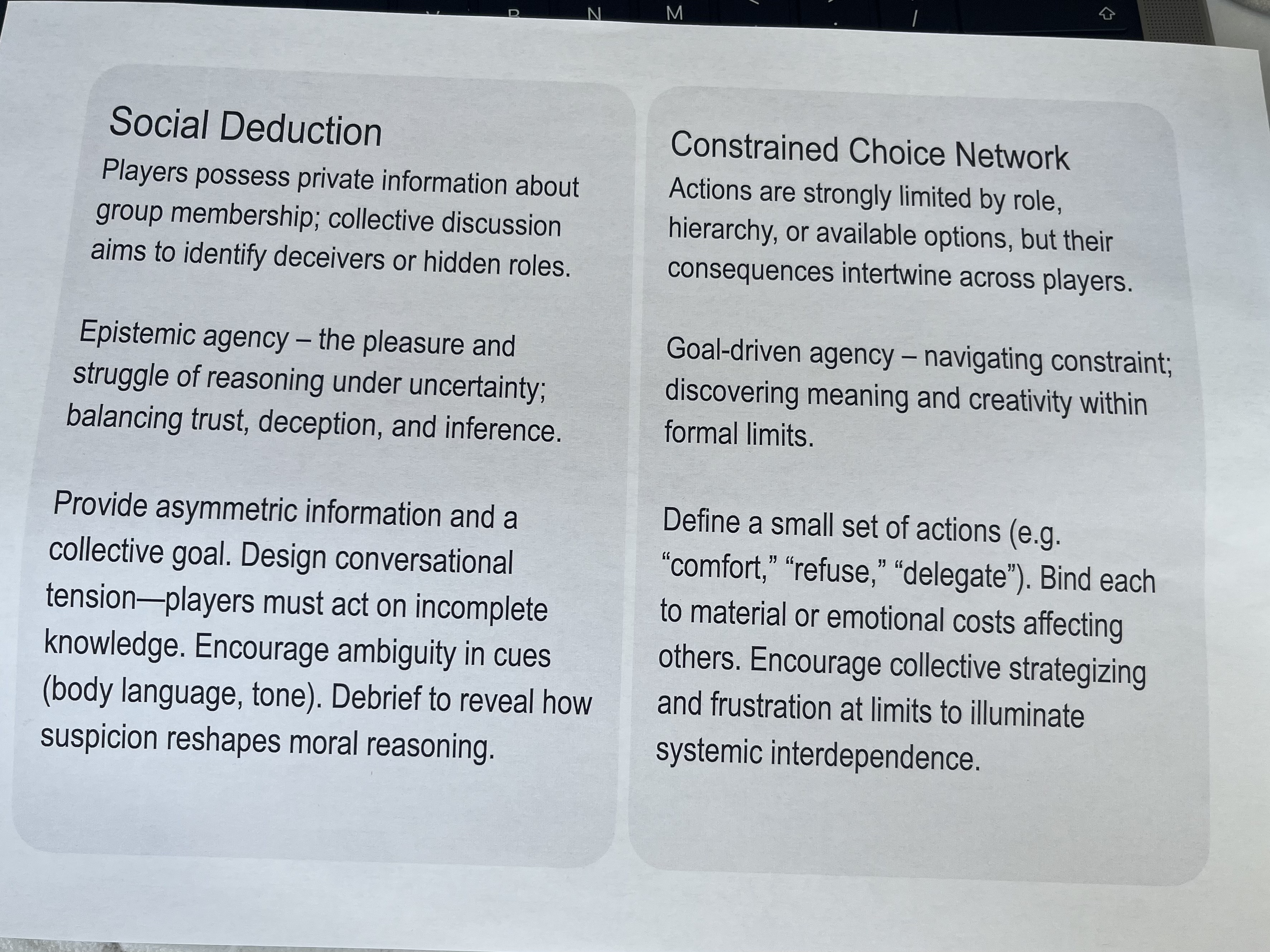
NUMBER OF PLAYERS:
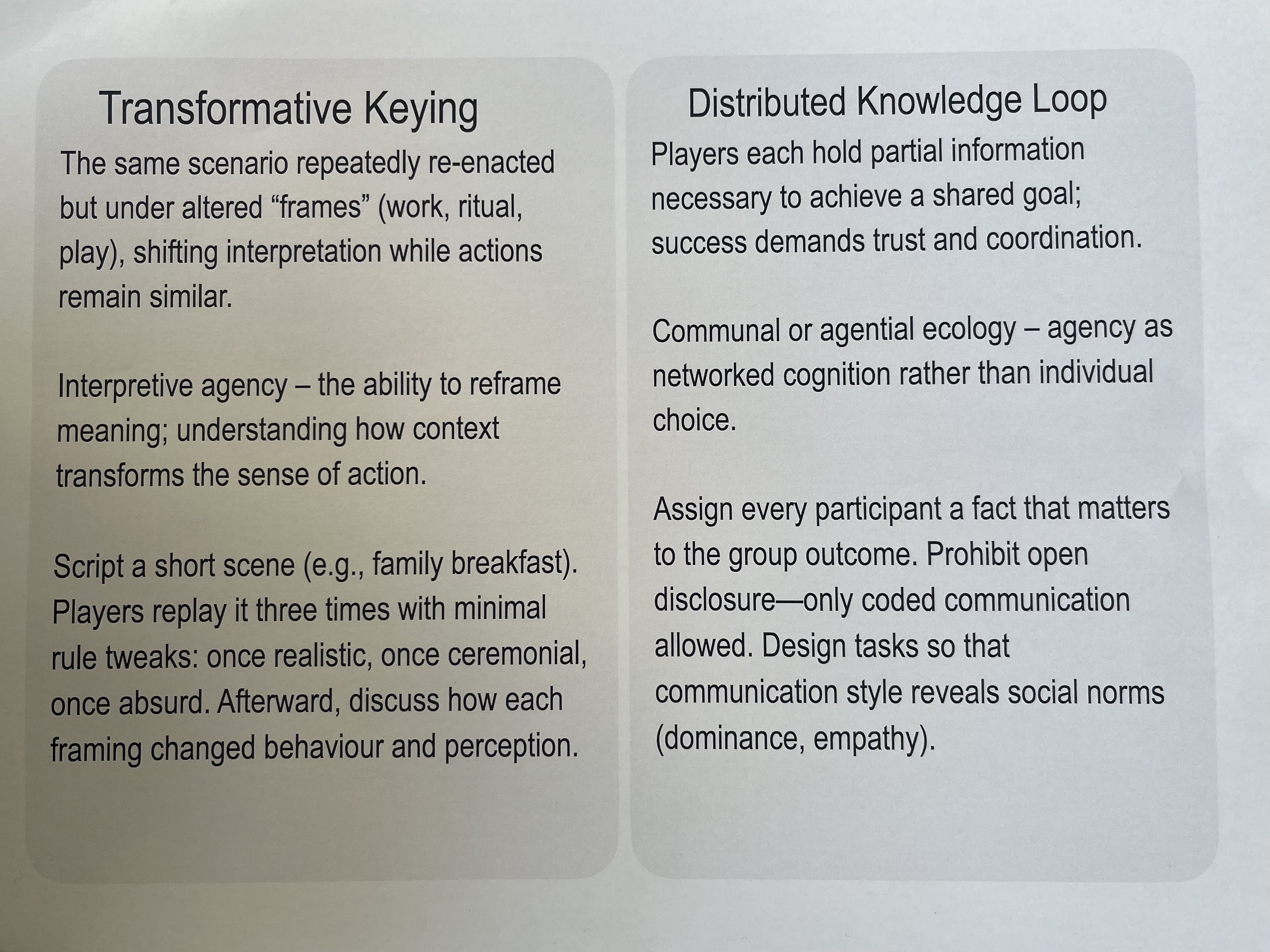
1.4. Mechanics You Are Drawn To From earlier discussions, which mechanics do you want to use or remix? List Short note that explains why? Social Deduction? I 🦤 Constrained Choice Network? Transformative Keying (re‑framing same scene)? I Distributed Knowledge Loop?
Hologram triangles? Real Game Play / Reality Leakage? https://www.reddit.com/r/rpg/comments/1znpsv/fiasco_fun_or_an_actual_fiasco_to_play/
2. 30 min – Ways of Publishing and Addressed Publics
2.1. Target Public(s) * Who are the publics for this game? (e.g. activists, hospital workers, teens, art audiences, policy makers, friends and family, online subcultures.) What prior experiences / assumptions do they bring everyone
2.2. Formats of Publication * How could the game be “published” or made accessible an intresting, catchy, sticky to the chosen publics? * Learning Workshops * Game in the off spaces * Exhibition / museum setting * Rulebook / zine * Website / online toolkit * Video / podcast / actual play recording * Social media * Other: 2.3. What It Problematizes and Propagates * What existing norms or myths does the game question or disturb for these publics? * What alternative imaginaries or practices does it propagate or make feel desirable or thinkable? * If your game were accused of being “propaganda,” what would it allegedly be propaganda for?
3. Type of Agency and Player Experience (60 min)
3.1. Core Forms of Agency (Nguyen) Select and describe 1–3: * Epistemic agency (reasoning under uncertainty, social deduction, figuring things out) * Goal‑driven / strategic agency (navigating constraints, pursuing structured objectives) * Interpretive agency (reframing meaning, changing how actions are understood) * Moral / deliberative agency (deciding between conflicting values) * Communal / ecological agency (being part of a networked intelligence / system) * Identity‑shaping agency (experimenting with who one is, alter‑egos) * Sensory / embodied agency (vertigo, rhythm, vulnerability in the body) Prompt: * What exactly do players get to do in the magic circle that they can’t easily do in everyday life? 3.2. Player Experience * What emotions and sensations could players encounter? (e.g. complicity, care, suspicion, wonder, boredom, vertigo, hope.) * What transformations do you want them to undergo, even if small? 3.3. Resources and Characters * Which roles/characters enable this agency? Describe 3–6 key roles. * What material or symbolic resources matter? (tokens, space, time, information, affection, status, health, money, secrets, etc.) * How do these resources move between players? (economies, rituals, exchanges, thefts)
4. Worldbuilding Techniques (40 min)
Use two of the four techniques, divide in smaller teams of 2/3 people, capture the drafts here: 4.1. From Character * Who is our primary lens character (or set of lenses)? * What everyday routines of this character reveal the world’s structure? 4.2. From Game Economy * What are the main “currencies” or flows of value? (e.g. care, attention, credits, reputation, warmth, data.) * How do players earn, spend, or lose them? * What inequalities are built into this economy? 4.3. From Conflict Dynamics * What are the central conflicts or contradictions (2–3)? * e.g. Duty vs affection, Technic vs Magic, Parent vs adolescent, School vs life. * How are players pushed to take positions? * Are conflicts resolvable, or mostly exposed and lived with? 4.4. From Environment / Infrastructure * What does the physical or mediated environment look/feel like? * What affordances and obstacles does it create? (doors, sound, light, rules of movement, platforms) * How does the environment act on players? ## 5. Applying Caillois game typology as Jokers (40 min) Here you focus on contest / competition as a temporary mode that can interrupt serious play. 5.1. Where Does AGON/ALEA/MIMICRY/ILINX Fit? * At what moments could the game briefly become a contest? * What is being competed over? (persuasion, care, status, precision, speed, style)5.2. Designing AGON Joker(s) Design 1–3 “joker cards” that, when played, shift the scene into contest mode. For each Joker: * Name: * Trigger: (who can play it, when) * Temporary win condition: (what counts as “winning”) * Effect on fiction: * How does it change relationships? * What does it reveal about the system (healthcare, family, school)? 5.3. Risks and Safeties * How to keep joker from collapsing into trivial competition? * What debrief or cool‑down is needed after each Joker is used? ## 6. Crafting and Recording the Scene (40 min) This is the live design + documentation section. 6.1. Scene Specification * Title of the scene: * Where are we? (space, time, mood) * Who is present? (roles, not player names) * Entry conditions: (how players enter, consent, briefing) 6.2. Player Interaction Rules * Turn‑taking? Interruptions? Who can address whom? * Use of previously defined mechanics (triangles, Real Game Play leakage, world protocols, AGON jokers, etc.) * What is forbidden (topics, actions, words)? * How is the scene stopped or transformed (safe words, frame shifts)?6.3. Script of the Played Scene (Live Notes) During play, the secretary writes: * Key moments, phrases, gestures * When frames shift (serious / ironic / ritual / contest) * When any Joker is used (note: which, how it felt) Format suggestion: Timecode (approx.) – what happened / key quote / mechanic used / emotional tone 6.4. Immediate Reflections (2–5 min after play) * What surprised you? * What felt too rigid, what too open? * What forms of agency did you actually feel, compared to what you planned? You can reuse this template for all three groups; they will “colour” it differently with their respective themes and references.